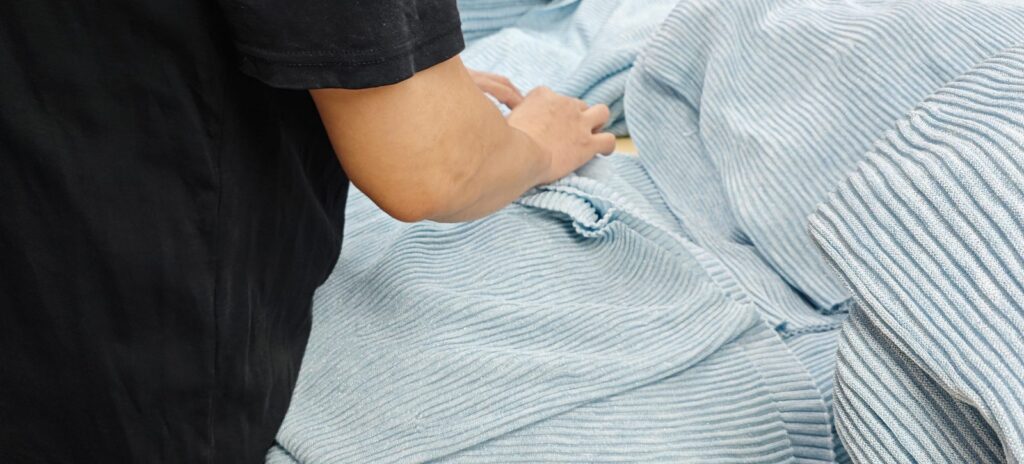
Custom Sweater Manufacturer in China: Sampling, Step by Step

Liming Knitwear
A 120-machine factory in Dalang, told from the floor — and why a new style always wastes panels on its first run, while putting it on more machines makes it slower, not faster
Ask a buyer why their first bulk run slipped, and you usually get one answer: the factory was busy.
It is almost never busy. It is a new style. And a new style cannot go straight onto 120 machines.
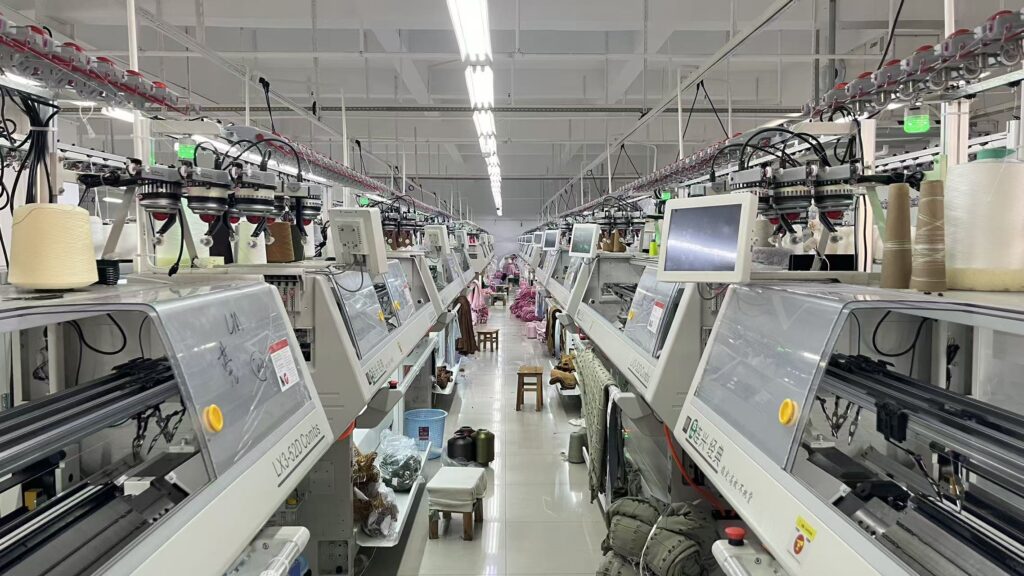
Liming is a custom sweater manufacturer in China, and in our workshop in Dalang we run 120-plus computerized flat knitting machines — Lianxing LX3-52D Combs beds, 12 gauge and 14 gauge as the main configuration, 3GG to 16GG across the floor. The bottleneck on a first order is almost never machine hours. It is the gap between “the program is ready” and “the machine is actually making sellable panels.” That gap has a name in our workshop: machine tuning — adjusting the density setting, the yarn feeders, the takedown tension and the pattern alignment until the panels coming off the bed are the ones you can actually sell. It is where the scrap comes from, and it is the thing most buyers never see in a quotation.
To be precise about what this is and is not: these are numbers for the cluster, not for this company. We are one of the 30,000 businesses in it. What it does tell you is that a factory here buys yarn, machines, spare parts, programmers and mechanics within a few kilometres — which is why a tuning problem gets solved in a morning instead of a fortnight.
Below is what actually happens during the sweater sampling process — why the first panels off the machine are scrap by design rather than by accident, and how we decide how many machines a new order should actually get. This is our own process experience, not a lab report.
A new style is not a new program
This is the first misconception to clear up.
A buyer sends a tech pack, we write the program, the program runs, first panels come off. Job done — that is how it looks from the outside. Inside, writing the program is maybe the easy third of the work.
A program is written for one specific yarn at one specific tension. Change the yarn, and the loop length you dialled in last week is no longer right.
A different dye lot, a different spindle count, a slightly different twist — the same program knits differently. Even the same yarn from a different batch behaves slightly differently on the needle bed.


So before the machine can run your style, four things have to be set and then checked against a real panel:
- Loop length (the stitch setting on the control panel) — sets stitch density, which sets both the weight and the final measurements.
- Yarn feeder position — affects tension at the needle and how cleanly the yarn enters.
- Takedown tension (the roller pull) — too loose and the panel rides up, too tight and the density distorts.
- Pattern alignment — on jacquard and stripe work, whether the colour boundaries land where the artwork says they should.
None of these can be confirmed from a screen. They are confirmed by knitting a panel and measuring it. That is the whole point, and it is why the first panels exist.
The first panels are scrap by design
Once the machine is running, we do not count the output as production. We measure it.
Density, width, length, pattern alignment, dropped stitches, float control on the back. If any of those is off, the loop length gets adjusted and we run again. Then we measure again.
Those panels cannot be sold. A panel at the wrong density is the wrong weight and the wrong size — it will not match the size chart, and it will not match the approved sample. So it goes to scrap.

That is where “the factory wasted our material” comes from. It is not waste in the sense of carelessness. It is the tuition on a new style, and every factory pays it. The only question is whether the factory tells you about it, and whether it is paying it once or ten times over.
We are not going to give you a fixed scrap quantity, because the honest answer is that it varies by style and we would be making the number up. A plain 12G knit with a basic yarn settles in fast. A jacquard with a colour boundary every few centimetres, or a slub yarn that snags, can take considerably longer.
If a supplier quotes you an exact first-run loss percentage for every style, that number is invented.
Why putting it on more machines makes it worse, not faster
This is the part that catches people out, and it is worth reading twice.
The intuitive move on a tight delivery date is: this is a 1,000-piece order, so put it on 20 machines and it will be done in half the time. It does not work that way on a new style, for three reasons.
One. Before the baseline exists, every machine is re-learning the same lesson.
The tuned parameters from machine A are a starting point for machine B, not a copy. Two machines of the same model, same gauge, bought the same year, will still differ slightly — needle bed condition, cam wear, takedown roller grip, even how the operator threads it. So each machine needs its own first panel checked. Put ten machines on it on day one and you have ten parallel experiments.
Two. If the parameters turn out wrong, they are wrong on all ten.
Tuning errors are discovered by measuring. If you discover on day two that the loop length was off, the panels run on all ten machines in the meantime are equally wrong. One machine’s mistake is a few panels. Ten machines’ mistake is a few hundred.
Three. Machine time is the cheap part. Yarn is the expensive part.
The whole reason to tune on one machine first is that scrap on one machine costs one machine’s worth of yarn, not ten.
So the correct sequence is not parallel. It is serial first, then parallel:
| Phase | Machines running | What we are doing | Sellable output? |
|---|---|---|---|
| Trial | 1 | Tune loop length, feeder, tension; measure panels | No |
| Confirmation | 1–2 | Re-run to confirm the settings repeat; check against approved sample | Partly |
| Baseline locked | 2–3 | Record settings; run the first sellable panels | Yes |
| Ramp | Full allocation | Spread across machines, first panel per machine checked | Yes |
| Steady state | Full allocation | Production | Yes |
The ramp phase is where the speed actually comes from. Once the baseline is locked, adding machines adds output nearly linearly. Before the baseline, adding machines adds cost.
So how many machines does your order actually get
This is where we get specific, because “it depends” is not an answer a buyer can plan around.
Our working ratios for a new style, 12G/14G plain or lightly patterned knit tops:
These are our own working numbers, not an industry standard, and they move. Two things shift them: the delivery date written in the order, and the style itself.
The delivery date in the order. If the contract says five weeks, we can run the trial phase calmly and ramp slowly. If it says two weeks, we compress the trial and take the scrap risk. Both are possible; they are not the same order.
The style itself. Pattern complexity, garment length, and whether the yarn snags all change how long the trial phase takes and how many machines can safely run in parallel once it is locked. A plain short cardigan and a long jacquard dress are not the same production problem even at identical quantity.
300 pieces on 5 machines and 1,000 pieces on 10 machines are not wildly different in calendar days.
The quantity tripled; the machine count doubled. A large part of the elapsed time is the fixed trial phase, which does not shrink because you ordered more. This is also why a 300-piece order is not cheap per piece — you are paying for a trial phase that a 3,000-piece order spreads across ten times as many garments.
What to put in the order when you brief a custom sweater manufacturer
Three things, and they cost you nothing to ask for.
A pre-production sample as the locked baseline
Not the development sample — a sample made on the production machines, with the production yarn, at the settings that will be used for bulk. Approve that one. Everything after it is measured against it.
A written note that settings do not change after approval
The most common cause of “bulk didn’t match the sample” is not a bad factory. It is somebody re-tuning after the sample was approved, because a later batch of yarn ran slightly differently. Re-tuning is legitimate. Doing it silently is not.
Ask what the first-run loss is, as a range, per style
If the answer is “none”, you are talking to either a trader who does not run machines, or someone who has decided to hide it. Both are worth knowing before you pay a deposit.
On timing: inside the sweater sampling process we quote 1–2 days for a simple style and 5–7 days for a complex style or a special yarn, because that range is what the trial phase actually takes. Anyone quoting a flat “3 days for all styles” is quoting an average they have not measured.
Where this reasoning breaks down
Being straight about the limits, because this framing gets over-applied.
Repeat orders are a different animal. A style we have run before already has locked settings on record. There is no trial phase to speak of — it goes almost straight to the ramp. If you are re-ordering, ignore most of this article and ask instead what changed: yarn lot, colour, size grading.
Very simple basics waste very little. A plain 12G crew neck in a standard yarn on a machine that has run similar work for years settles quickly. For that style the first-run loss is small enough that arguing about it is a waste of everyone’s time. The problem is real; it is not universal.
We cannot give you zero scrap. Nobody can, on a new style. If a factory promises zero first-run loss on a style it has never made, that promise will be paid for somewhere — in a longer lead time you were not told about, or in panels that get shipped anyway.

And we do take shortcuts when pushed. If a buyer insists on an impossible date, we will put more machines on a new style than the ratios above, accept the extra scrap, and eat the cost — or price it in. I would rather tell you that now than explain it to you after the fact.
What our knitwear factory actually knits
Everything above is about one process — tuning. But a buyer usually needs the other half of the answer first: can you make my garment at all, in my yarn, at my gauge? So here is the range, in the terms we actually quote it — the numbers a custom knitwear manufacturer should be prepared to put in writing before you send a deposit.

Knit dresses
V-neck, crew and collared. A-line, straight, pleated and fishtail hems. Sleeveless through long sleeve.
Style 1 · 20 · 21
Cardigans & knit blazers
Button, snap and zip plackets. Ribbed or plain body. Collared blazers with structured shoulders, knitted in one piece rather than cut and sewn.
Style 8 · 22 · 24
Vests & waistcoats
Chanel-style contrast trim, double-breasted, rib-textured. Usually 12G or 14G so the trim sits flat.
Style 2 · 3 · 4
Pullovers & tops
Set-in, raglan, drop shoulder and bubble sleeve. Crew, scoop and boat necklines.
Style 9 · 11 · 23
Sets, skirts & trousers
Matched top and skirt cut from the same yarn lot, so the colour matches across both pieces. Straight, A-line and pleated skirts; wide-leg and tapered trousers.
Style 12 · 10 · 139
Trim & surface
Rhinestone and metal buttons, beading, lace insertion, jacquard, pleating, fringe. These are the parts that decide your cost, not the body panel.
Decorative work
Gauge is where most enquiries get filtered. We run 3GG to 16GG on site, with the working core at 12G and 14G. If your style needs 7G or 9G chunky work we have it, but fewer machines — which changes what quantity is worth quoting. Say the gauge early and the whole conversation gets shorter.
Two yarns do most of our volume. Ice-silk is our summer mainstay — soft hand, good drape, and it moves in the wash, which is exactly why the dimensional test in the next section is not optional. Core-spun yarn gives us structure and recovery for the tailored-looking pieces: the collared vests and the Chanel-trim waistcoats. If you are working in wool, cashmere or a blend, we quote it, but we will ask for the yarn spec before we quote the price — the fibre decides the machine and the finishing, and those decide the price.
One honest limit: we are a flat-knitting factory, not a full-package company. We knit, link, trim, mend and press. We do not do embroidery, printing or garment dyeing in-house; those go to partners we have used for years, and they show up in your lead time as a separate line. Better you know that now.
Styles we have run recently
Style numbers are our own internal references. They are here so that when you send us a tech pack, you can point at something and say “like that one” instead of describing a silhouette in words.


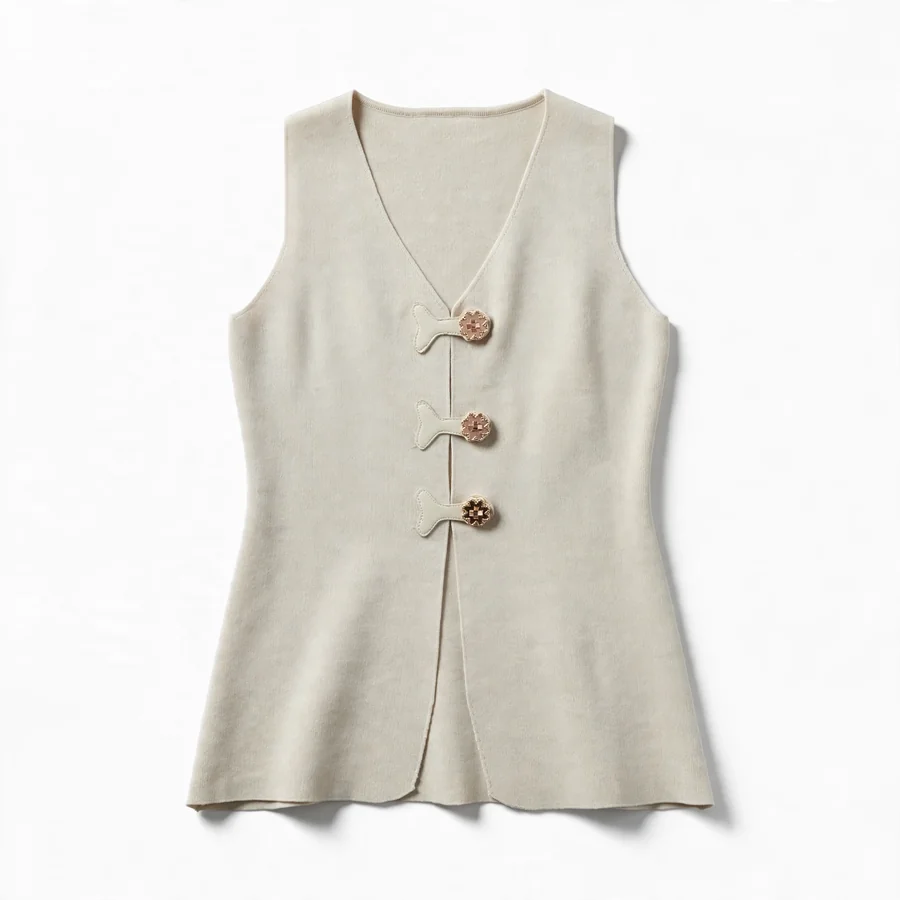

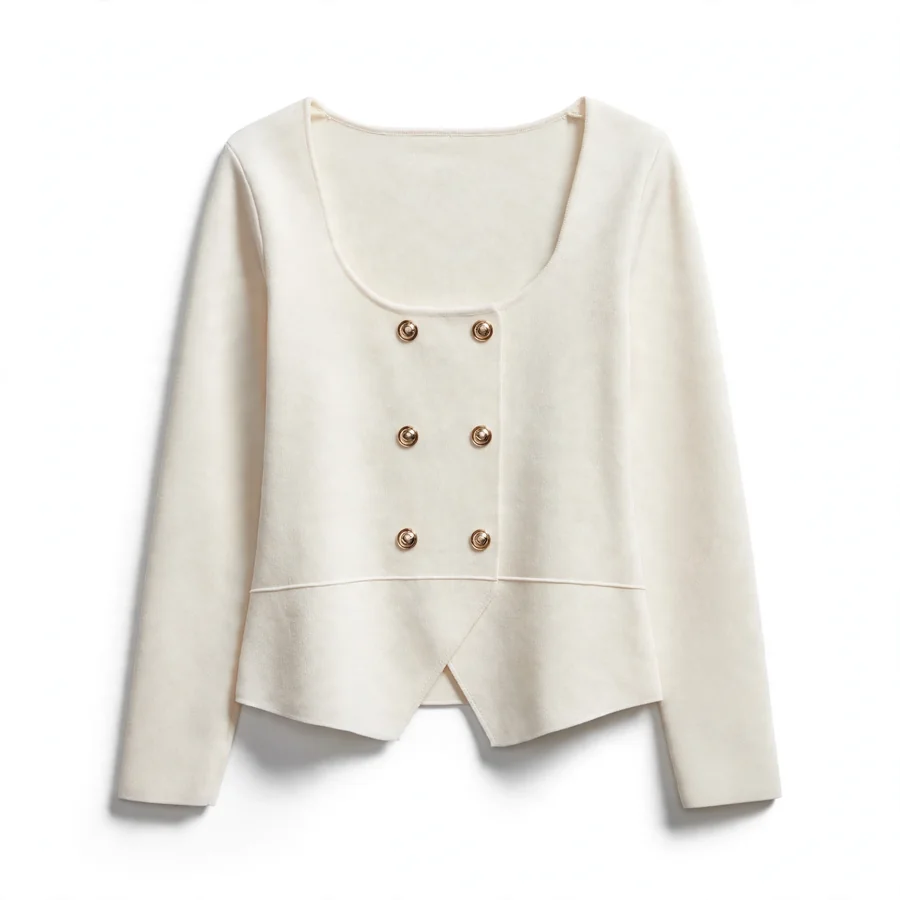
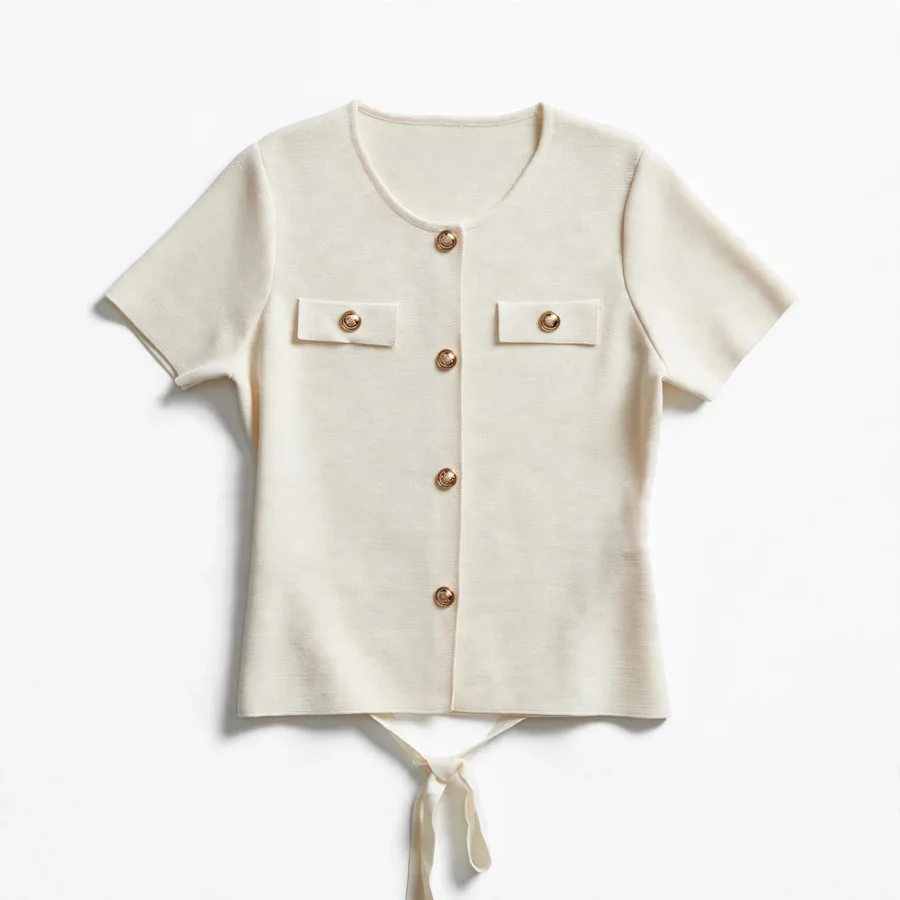
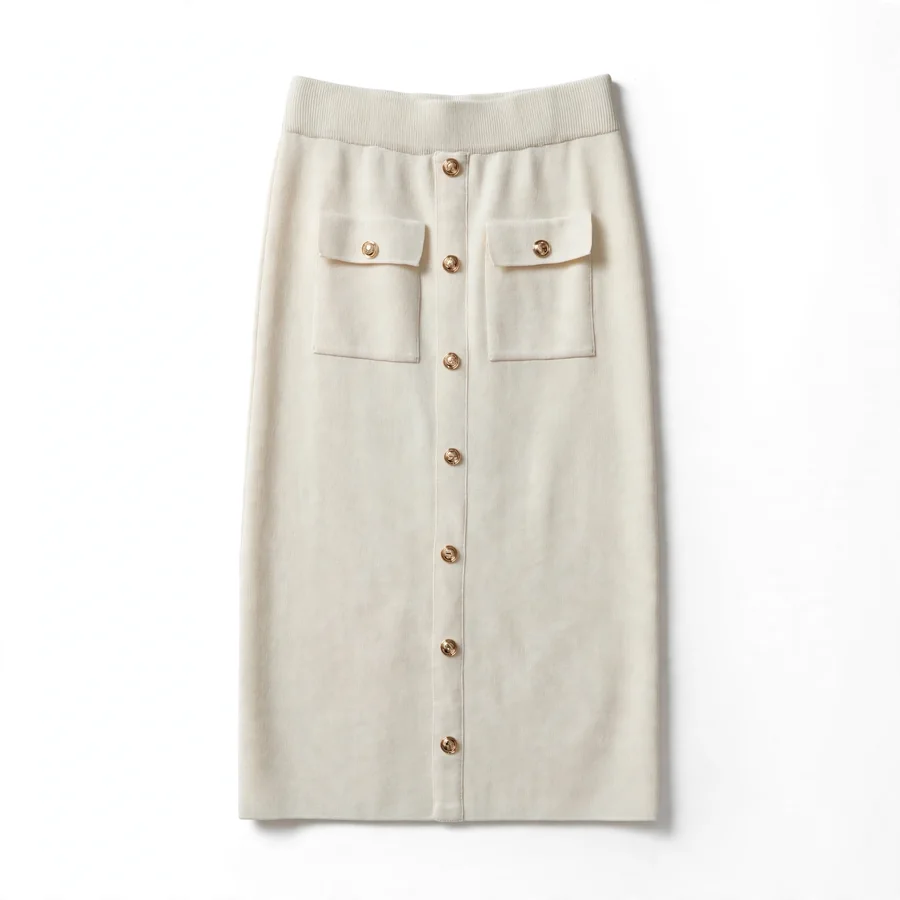


These are our own styles, photographed as they came off our machines — not renders and not borrowed catalogue shots. Every one of them was knitted on the 12G and 14G beds described above. Ask us for the style you want and we will send the sample, the yarn composition and the gauge it runs at.

The standards we are measured against
This is the part that separates a supplier who has done the homework from one who has not. Every claim below is a published test method, not our opinion. If a factory cannot name the method behind a quality promise, there is no method.
| What gets measured | Method | What to ask for |
|---|---|---|
| Dimensional stability after washing | AATCC 135 · ISO 6330 (wash) with ISO 5077 (measurement) | Shrinkage % in length and width, after 3 home launderings — one wash proves very little |
| Pilling resistance | ISO 12945-2 (Martindale) · ASTM D4970 | The grade (1–5) and the number of rubs it was graded at. A grade 4 at 500 rubs means nothing |
| Colourfastness to washing | AATCC 61 · ISO 105-C06 | Two grades, not one: shade change, and staining onto the adjacent fabric |
| Colourfastness to rubbing | AATCC 8 · ISO 105-X12 | Dry and wet reported separately — wet rub is where dark colours fail |
| Seam strength | ASTM D1683 · ISO 13935-2 | Force before the seam opens, on the shoulder and armhole seams specifically |
| Spirality (skew) after wash | AATCC 179 | % skew — the reason a knit dress twists at the side seam after two washes |
Labelling is a separate discipline, and it is where shipments actually get held. The EU and the US do not run the same rules, and a single label design rarely satisfies both.2 In the EU, Regulation (EU) No 1007/2011 allows only the fibre names in its Annex I, requires every fibre stated as a percentage in descending order, requires the label to stay legible for the life of the garment, and requires the language of the member state where it is sold. In the US, fibre content, country of origin and the maker’s identity sit under 16 CFR Part 303, while care instructions are a separate rule, 16 CFR Part 423. Care symbols differ too — ISO 3758 in Europe, ASTM D5489 in the US. They look alike and are not interchangeable.
One thing that catches EU buyers out is EPR. Under extended producer responsibility schemes for textiles, whoever places the goods on a member state’s market has to be registered there — which is why an EU authorised representative is not optional paperwork. We have both in place: an EU authorised representative, and EPR registration. If your current supplier cannot answer that question in one sentence, that silence is the answer. Which member states we are covered in, ask us and we will send the paperwork.
What we will not do is claim certificates we do not hold. What we can tell you is what our QC is written against, and that we will send the test report for your specific order when there is one to send. If your programme needs OEKO-TEX or GRS on the yarn, that is a question for the yarn mill — we will tell you what is available before you commit, not after.
What buyers ask us about this
No. We can compress it — more people on the tuning, machines running around the clock — but the measurement step cannot be removed. Compressing it raises the scrap risk, and we will tell you when we are doing that.
Usually one of three things: the bulk sample was made on a different machine than the bulk run, the settings were re-tuned after approval because a new yarn lot behaved differently, or the yarn itself changed between sample and bulk. All three are traceable if the factory records settings and yarn lots. Ask for those records.
Not in any way you can rely on. Gauge changes the stitch size, not the tuning process. A 14G plain knit and a 3G chunky both need a trial phase; the chunky one is often easier to see problems on and harder to fix, because there is less room to adjust.
For a style we have not run before, plan on the trial and confirmation phases taking roughly the same time as sampling — 1–2 days simple, 5–7 days complex — plus the ramp. It is not instant, and it is not the same for every style. If a supplier gives you one number for all styles, ask them what they measured.
3GG to 16GG on site, out of 120-plus computerized flat knitting machines. The working core is 12 gauge and 14 gauge, because that is where most of the market sits. Chunky work at 3G, 5G and 7G we can do, but on fewer machines — so the minimum quantity that makes sense is higher. Tell us the gauge in your first email and the quoting gets much faster.
Dimensional stability to AATCC 135 / ISO 6330 with ISO 5077; pilling to ISO 12945-2 or ASTM D4970; colourfastness to washing to AATCC 61 / ISO 105-C06; to rubbing to AATCC 8 / ISO 105-X12; seam strength to ASTM D1683 / ISO 13935-2; spirality after wash to AATCC 179. The full table is in Section Nine. What we do not do is claim certificates we do not hold — ask us what is current for your order.
On labelling, yes — we work to Regulation (EU) No 1007/2011 and ISO 3758 care symbols. On EPR, we hold an EU authorised representative and EPR registration. What we will not do is tell you a certificate covers something it does not: OEKO-TEX and GRS are yarn-level credentials, and neither makes a care label legally correct.
Where these figures come from
Nothing here is a number we invented. Where a figure is regional industry data or a published test method, it is cited below so you can check it yourself.
- Dalang cluster output, business count, employment, machine count and chain turnover — People’s Daily, English edition (republished 24 Aug 2026), and the Dongguan Municipal Government (June 2026). Both report approximately 900 million sweaters a year, one in five worldwide, RMB 72 billion in chain turnover, 30,000 businesses, 200,000 workers and 150,000 computerized flat knitting machines. Cluster-level figures — not this company.
- EU fibre composition and labelling — Regulation (EU) No 1007/2011, Articles 5, 9, 14 and 16. In force since 8 May 2012.
- US fibre content, origin and maker identity — 16 CFR Part 303. US care labelling — 16 CFR Part 423.
- Test methods cited in Section Nine — AATCC methods 8, 61, 135 and 179; ISO methods 6330, 5077, 12945-2, 105-C06, 105-X12, 13935-2 and 3758; ASTM methods D4970, D1683 and D5489. Standard numbers cited as published. Test reports for a specific order available on request.
Everything else — the tuning sequence, the machine ratios, the 1–2 and 5–7 day sampling ranges, the 300-versus-1,000-piece arithmetic — is our own workshop practice, observed on our own floor. It is presented as experience, not as a study.
Tell us what you are making
Send four things and we will tell you honestly what the trial phase will look like for your style — including whether it is one of the ones that settles fast. You are writing to a custom sweater manufacturer, not to a trading desk: the person who answers has stood at these machines.
- Style reference or a clear photo
- Quantity per colour and per size
- Target market — this drives labelling, sizing and compliance, not just price
- The hand-feel you want: cool and drapey, or soft and lofty
Send a style reference on WhatsApp
Or email sychen@limingknitwear.com — goes to Zhao Sheng directly.
This article describes our own workshop practice as a knitwear factory. Final specifications are whatever both sides confirm in writing for a specific order. Figures given as ranges are our historical experience, not guaranteed values.
Photography: workshop images by Liming Knitwear; two illustrative images via Pexels under the Pexels License.