Custom Cardigan Sweater Manufacturer: A Buyer Spec Sheet

A cardigan is not a sweater with a gap down the middle. Its front edge is a free edge that carries the whole garment, and five specs on that edge get decided by whoever fills them in first. If you leave them blank, the factory decides.
“The sample was fine. The bulk came back and the placket waves after the first wash.”
A buyer’s email, on a 400-piece cardigan order
We are not going to argue with that email. The wave was predictable, and it was decided months before the parcel shipped — on one line of a spec sheet, a line that was blank. As a custom knitwear manufacturer in Dalang we make cardigans the way we make everything else: 120-plus flat knitting beds running 3GG to 16GG, about 1.6 million pieces a year, knitting, linking, sewing and pressing in the same building. It is a sweater factory in the literal sense: the knitting beds are ours, not booked from someone else. The knitting part is the part buyers worry about. It is rarely the part that goes wrong.
So this page is a spec sheet with an essay attached. It is written for the buyer who is ordering custom cardigans for the first time and does not yet know that the front edge is the hard part — and for the one who has ordered before and got a cardigan back that swung open like a coat.
Why a cardigan is not a sweater with a gap in it
Count the pieces. A pullover front is one panel: no free edge, no closure, nothing to hang from. A cardigan front is two mirror panels, each with its own shaping, each with an edge that has to be finished and then reinforced, plus a closure that has to sit flat on a surface that stretches in four directions. When the cardigan is worn open, the front edge holds the weight of both panels. Nothing does that job on a pullover.
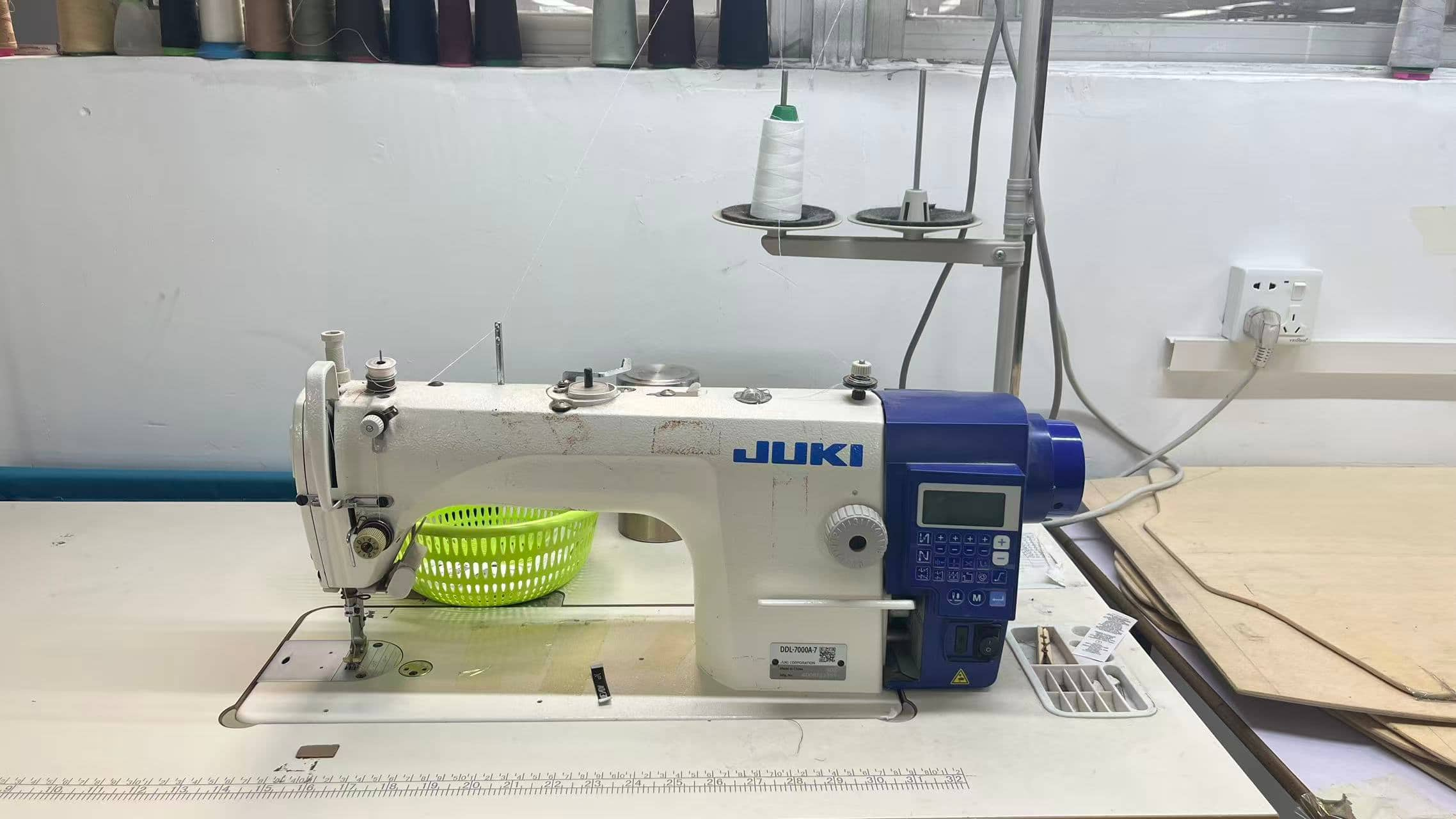
It also changes the labour. A pullover is shoulder, two side seams, two sleeve seams and you are done. A cardigan adds two placket attachments, a buttonholing pass, button sewing, and usually a neck band — work that happens at the linking machine and the lockstitch station, not at the knitting bed. That is why a cardigan quoted at the same yarn weight as a pullover still costs more, and why a cardigan sweater supplier who quotes it as if the extra steps were free is telling you something about how carefully they read the brief.
The six parts of a cardigan, in the order they get decided
Every cardigan in our building goes through the same six decisions. They are listed below in the order they have to be locked, because each one constrains the next: the placket type fixes the width, the width fixes the button size, the button size fixes the buttonhole spacing, and the spacing has to survive whatever the rib band does at the hem.
Placket: knitted-in, self-fabric, or rib strip
There are three ways to finish the front edge of a custom cardigan, and they are not interchangeable in price or in behaviour.
- Knitted-in. The machine knits the band as part of the panel, so there is no seam along the edge at all. Cleanest result and the least handling. The catch: the band width is baked into the program, so changing 4 cm to 5 cm is a re-program, not a trim adjustment, and it only works on simple structures.
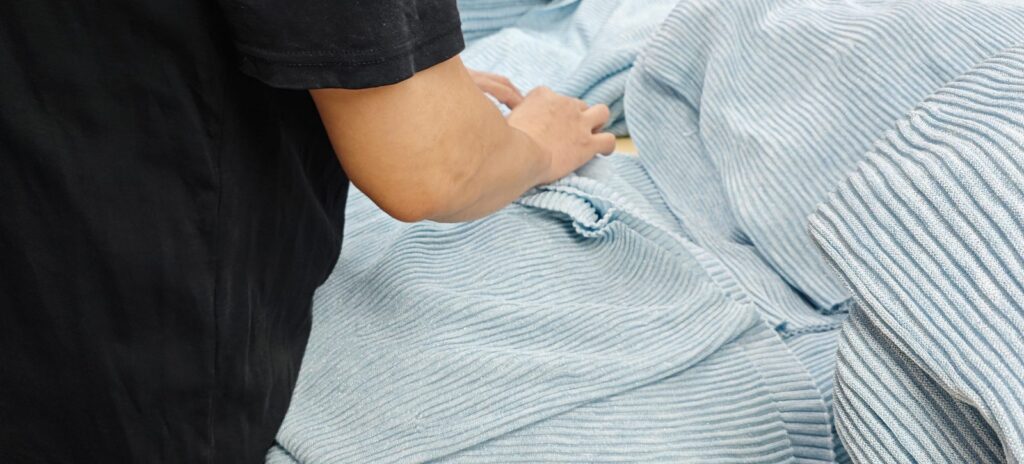
- Self-fabric strip. A strip knitted separately, folded and attached, usually over a fusible tape. This is the workhorse for cabled, jacquard and multi-colour bodies. Its weakness is the one in the email at the top: a knit strip is stretchy in the same direction the panel is stretchy, so without tape it grows.
- Rib strip. 1×1 or 2×2 rib, linked on. Best recovery, holds the edge straight through washing, and it is what most personalized cardigan sweaters in the market use. The cost is bulk at the join, which is noticeable on 3GG to 5GG bodies.
Placket width is a ratio, not a number
Buyers tend to send a single figure for a custom cardigan, usually copied from a garment they like. It rarely transfers. A narrow band that looks refined on a 14GG body is a ribbon on a 5GG chunky, because the panel it has to control is three times heavier. The band has to be wide enough for two rows of stitching plus the button plus an edge allowance, and it has to scale with the panel weight, not with the look you saw on a different fabric.
Buttonholes decide the buttons, and the motif decides the buttonholes
A cut machine buttonhole needs a stable substrate, which means interlining, which changes the hand of the edge. On a loose or lofty knit the cut can run, and the honest answer is a hand-bound buttonhole instead — slower, better, and something a supplier who only quotes by the piece will not offer you. Spacing is then derived from button diameter and front length, and the derivation has a direction: from the hem up, not from the neck down. Spacing from the top is the most common reason a last buttonhole lands inside the rib band.
One more constraint nobody mentions: if the body carries a cable, a jacquard or a Fair Isle repeat, the buttons have to land on the motif. A perfectly straight placket with buttons that straddle the pattern reads as crooked, and no amount of pressing fixes it. That is why custom cardigans embroidered or patterned at the front need the artwork before the panels are programmed, not after.
The rib bands are what actually keep the fronts closed
The hem band is not decoration. It is the spring that pulls the two fronts back towards each other. Too loose and the cardigan hangs open like a coat, with the fronts curling outward at the hem; too tight and the hem grips while the placket above it has nowhere to go, so the edge waves — which is the failure in the email, arriving six weeks later than the decision that caused it.
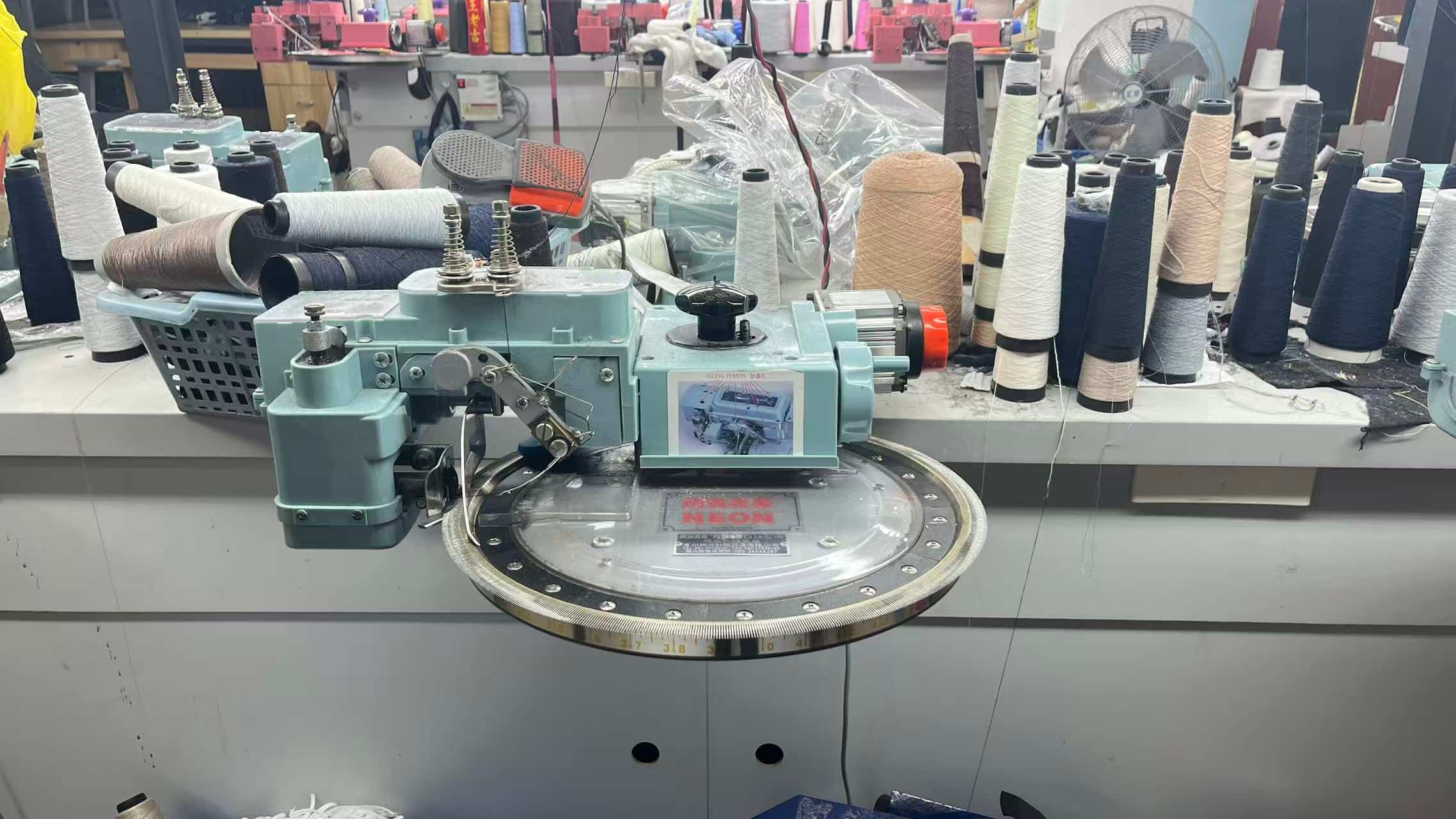
Hem, cuff and neck should come off the same rib quality. A 1×1 hem with a 2×2 cuff is legal and looks like a mistake nobody can name. On wholesale knitwear runs we keep the rib on the same machine family as the body for exactly this reason.
The front panels are not the back panel
Two things get left out of most custom cardigan sweater spec sheets. First, the front panels of a custom cardigan have to be wider than half the body, because they overlap at the closure. Second, they need extra length. A cardigan worn open hangs its fronts from the shoulder seam, and knit stretches under its own weight; a front cut to exactly the back measurement will finish two centimetres short by the time it has been on a hanger for a day, and the customer will call it a defect. The allowance depends on yarn weight and on how open the garment is worn, so we quote it per style rather than publishing a single number that would be wrong for half of them.
And if the wave happens anyway, the first thing to check is not the washing machine. It is whether the placket and the body came from the same yarn lot. Two lots shrink differently, and a placket that shrinks at a different rate from the panel it is sewn to cannot sit flat — that is a materials decision taken at the mill, invisible on the spec sheet, and it is why we test dimensional change to ISO 6330 and ISO 5077 rather than trusting the yarn label.
What the brief says, and what the factory hears
This table is the short version of every cardigan order that started badly. None of these lines is stupid; each one leaves a gap that somebody downstream fills with the cheapest assumption available.
| What the brief says | What we have to assume | What it costs you |
|---|---|---|
| “Standard placket” | Self-fabric strip over tape, hem-spaced buttons, interlined hole | Your edge will not match your last supplier’s — and you will notice it at the photo shoot |
| “Buttons: TBC” | We knit and finish the fronts at our default spacing | Changing the button later means re-doing the fronts, not re-sewing buttons |
| “Same as last season” | Whatever is in the sample bag you sent, at whatever gauge it was knitted | If the sample was 14GG and your new order is 12GG, it is a different garment |
| “Gold buttons, you source” | We quote the trim and its minimum separately | Trim minimums can exceed the garment minimum — 50 pieces of cardigan, 2,000 pieces of button |
| “Wash: gentle” | We test to the programme you name, not to a feeling | No named programme, no comparable result — and a wave you cannot diagnose |

The cardigan spec sheet we work from
Copy this custom cardigan spec sheet into your tech pack. It is not proprietary; it is just the list of fields that, if left blank, get decided by whoever is holding the knitting program. Fourteen lines, and the first four are the ones that cause the arguments.
| Field | Options you are choosing between | What it changes |
|---|---|---|
| 1. Style reference | Photo, sketch, or a physical sample in the post | Whether we reverse-engineer or design; a sample beats a photo every time |
| 2. Gauge | 3GG to 16GG, 12GG and 14GG most common | Hand, weight, and the maximum width of placket that will behave |
| 3. Placket type | Knitted-in / self-fabric / rib strip | Price, edge stability, and whether the width can be changed cheaply |
| 4. Placket width | Finished width in cm, flat or rolling | How the fronts sit when open; whether the hem curls |
| 5. Interlining | None / fusible tape / full front tape | Buttonhole quality and the stiffness of the edge |
| 6. Button | Size in ligne, material, holes, finish | Buttonhole size, spacing, and the trim minimum |
| 7. Button count | Number and vertical placement | Whether the last hole falls in the rib band |
| 8. Buttonhole | Machine cut / hand-bound / hidden snap / loop and button | Labour, durability on loose knits, and whether tape is needed |
| 9. Rib structure | 1×1 / 2×2, and band width for hem, cuff, neck | Recovery, how the fronts hang, and whether the hem flips |
| 10. Front length | Same as back, or with an allowance | Whether the fronts finish level after a day on a hanger |
| 11. Pocket | None / patch / welt / in-seam | Extra panel, extra handling, and a second chance to misalign a repeat |
| 12. Pattern alignment | Buttons to motif, or motif to buttons | Whether a straight placket looks straight |
| 13. Colourways | Number of colours and the split | The MOQ arithmetic — 50 pieces per style per colour, not 50 in total |
| 14. Test programme | ISO 6330 wash procedure, ISO 5077 dimensional change | Whether “it shrank” is a claim or a measurement |
Which placket, in one branch
If you only take one decision from this page, take this one. Everything else on the sheet is adjustable after the sample; the placket type is the one that gets expensive to change.
Frequently asked questions
Can you copy a cardigan we already sell?
Send one physical piece, not a photo. We measure it, reverse the program and rebuild the spec sheet from it, then list the fields that were left implicit by your previous supplier. That list is usually where the surprises are, and it is cheaper to find them before the first bulk run than after.
What is your MOQ on custom cardigans?
50 pieces per style per colour, the same floor as everything else we make, and samples start at one piece. The number that moves is the colour count, not the style count: three colours is three dye lots and is priced as one order of 150. Where that floor comes from is a separate page.
Do you make embroidered or personalised cardigans?
Yes, and the front is the part that needs planning. Custom embroidered cardigans are the case where the artwork and the placket compete for the same 4 cm. Embroidery on a panel changes how that panel behaves at the placket, so the artwork has to exist before the panel is programmed. Personalised names and initials at 50 pieces are fine; the constraint is the embroidery minimum on thread colours, not the garment.
Can you supply the buttons and labels?
We can source the trim package, and we will tell you the trim minimum before you commit, because it frequently exceeds the garment minimum. If you already have buttons, send them with the brief; snapping a button to a hole is cheaper than designing both from scratch.
How long does a cardigan take?
Samples are 3 to 7 days depending on the body — a plain 12GG cardigan sits at the short end, a cabled one with a hand-bound buttonhole at the long end. The sampling sequence is the same as any other style. Bulk is 20 to 25 days after sample approval, and the placket and buttonhole decisions are what keep it at 20 instead of 25.
What actually kills a cardigan in production?
Two things, in this order: a placket with no substrate, and a buttonhole cut into a knit that could not take the cut. Both are invisible on a photo, both survive the sample, and both show up after the first wash — which is why we would rather argue about the spec sheet now.
Send the front edge, not the whole mood board
A sketch plus the placket type, button size and gauge is enough for a custom knit sweater manufacturer to quote a custom cardigan properly and to tell you which field will cause trouble at your quantity. Usually back within one working day.
Sources
- Machine capability, MOQ and lead times are our own published figures: 120-plus flat knitting machines, 3GG to 16GG, MOQ 50 pcs per style per colour, samples from 1 piece, bulk 20–25 days.
- Dimensional change testing: ISO 6330:2021 (domestic washing and drying procedures for textile testing) and ISO 5077:2007 (determination of dimensional change in washing and drying).
- Fibre composition and labelling: Regulation (EU) No 1007/2011 — the reason we name fibre percentages on the care label rather than trade words.
- Restricted substances in yarn and trims: OEKO-TEX Standard 100.
- Placket widths, button counts and front length allowances are not published here as fixed numbers, because they move with gauge, yarn weight and how the garment is worn. We confirm them per style on the spec sheet before knitting.