Sweater Shoulder Types: Raglan, Set-In, Drop & Saddle

A buyer asks for “a raglan” and attaches a set-in reference. It is an easy mistake, and it is an expensive one: changing the shoulder can move ten to twenty percent of the armhole stitch count from the body to the sleeve, and reshaping a whole batch of sleeves is not a five-minute fix.

“Can you make this in a raglan?” — attached: a set-in sweater with a crisp tailored shoulder.
The shoulder of a sweater is not a styling choice that gets resolved at the drawing board. It is a knitting decision that decides how the body and the sleeve are shaped, how the seam is finished, and how many stitches sit at the armhole. For a sweater manufacturer the four common constructions — raglan, set-in, drop shoulder and saddle — are four different jobs on the machine, not four names for the same sweater.
It matters to a buyer because the shoulder type drives cost, lead time, and fit. Pick the wrong one and the sample comes back wrong; fix it after bulk starts and a whole batch of sleeves is scrap. This article is written from the knitting floor, not a fashion glossary, so the comparisons below are about stitches, seams, and machines.
“What is a raglan?” is the wrong first question. The right one is: where does the seam sit, and who shapes it — the machine or the linker?
A garment can look almost identical in two shoulder types and still need a completely different knitting programme and finishing line.
- Raglan runs one diagonal seam from the neckline to the underarm; the sleeve is knitted as one piece with the body or a raglan yoke, so there is no separate sleeve cap to set in.
- Set-in joins a separately knitted sleeve with a curved cap to a curved armhole, stitch by stitch on the linking machine — the most precise and the most labour-intensive.
- Drop shoulder lowers the seam below the natural shoulder point; the body is wider and the sleeve is simpler, which is why it reads as relaxed and is usually cheaper to make.
- Saddle is the hybrid: a set-in sleeve plus a shaped shoulder piece filling the gap between neck and sleeve, common in cricket and heritage knitwear.
All four are fully-fashioned knitwear we produce. The question is which one your style actually needs, not which one sounds right.
Four shoulders, four different knitting jobs
Before the detail, here is the whole picture on one screen. The columns are the things a factory actually plans around: where the seam lands, how the sleeve is knitted, what the construction is best at, and the failure we see most when a spec is vague.
| Type | Where the seam sits | How it is knitted | Best for | Failure we see most |
|---|---|---|---|---|
| Raglan | Diagonal, neckline to underarm | Sleeve and body share the raglan line; often one piece | Casual, colour-blocked, easy movement | Diagonal worked on the wrong side, so the seam spirals |
| Set-in | Curved, around a shaped armhole | Separate sleeve with a cap, linked to the body | Tailored, structured, dressy | Cap too tall or too shallow, so it puckers or gaps |
| Drop shoulder | Below the natural shoulder point | Wider body, simpler straight sleeve | Oversized, relaxed, unisex | Too much fabric at the underarm, so it bags |
| Saddle | Curved, with a shaped piece on top | Set-in sleeve plus a separate saddle | Heritage, cricket, colour interest | Saddle width mis-set, so the shoulder ridges |
Raglan: one piece from cuff to neckline
In a raglan the sleeve is not a separate cap dropped into an armhole. It is one piece that runs from the cuff all the way up to the neckline, and the seam is a single diagonal line from the neck to the underarm on each side. Because there is no curved cap to shape, the “shoulder” is just the point where the raglan line meets the neck.
How it is knitted. The raglan line is shaped by increasing or decreasing stitches along the diagonal as the piece grows. The total number of stitches removed along both raglan lines equals the difference between the body width at the underarm and the neckline width. Get that balance wrong and the diagonal will not meet the neck cleanly.
When to use it. Raglan is the natural choice for colour-blocked styles, because the diagonal is a perfect place for a contrast colour, and for any style where ease of movement matters more than a sharp shoulder. Raglan sleeves also avoid the most fiddly linking operation, which is why they are common in casual and childrenswear.
Set-in: the tailored shoulder
The set-in sleeve is the one people mean when they say a sweater has a “proper shoulder”. A separate sleeve is knitted with a curved cap, and that cap is joined to a curved armhole on the linking machine, stitch by stitch. The result is a defined shoulder and a clean line from neck to sleeve.
How it is knitted. The sleeve cap is shaped over a height of several centimetres by decreasing stitches along both edges of the cap. The total stitches decreased along the cap must match the stitches increased along the armhole; if the cap is too tall the seam puckers, if too shallow it pulls tight across the top of the arm. This matching is the single most common thing a sweater manufacturer has to get right on a tailored style.
When to use it. Set-in gives the most structured, dressy shoulder, and it is the default for fine-gauge women’s and men’s knits where the shoulder line is part of the design. It costs more in linking time than a raglan or a drop shoulder, and that labour is the reason a tailored shoulder is rarely the cheapest option.
Drop shoulder: the seam moves down
A drop shoulder does exactly what the name says: the seam that joins the sleeve is placed below the natural shoulder point, sometimes several centimetres down the upper arm. The body is knitted wider at the top, and the sleeve is usually a simpler, nearly straight tube attached at that lowered line.
On the machine. There is no shaped cap and no precise armhole curve to match, so the programming is simpler than a set-in. The cost is fabric: a drop shoulder sweater uses more yarn at the shoulder and the underarm, and if the drop is too deep the cloth bags under the arm. The shoulder point is a measurement, not a seam, so the spec has to state how far the seam drops.
When to use it. Drop shoulder is the relaxed, oversized, unisex look, and because the sleeve is simple it is usually the cheapest of the four to produce. It is also unforgiving in the opposite way to set-in: too little drop looks like a mistake, too much looks like a tent. State the drop in centimetres and the fit is controllable.
Saddle: the hybrid shoulder
A saddle shoulder sits between raglan and set-in. The sleeve is set in much like a set-in, but an extra shaped piece — the saddle — is knitted and linked across the top of the shoulder, filling the area between the neckline and the sleeve. You see it on cricket sweaters and on heritage-style knits where the shoulder is a design feature in its own right.
How the saddle is made. The saddle is a small shaped panel, typically a few centimetres wide across the shoulder, knitted separately and linked in along both its edges. It is the most parts of the four constructions: body, two sleeves, and two saddles, each joined on the linking machine. The width of the saddle decides whether the shoulder sits flat or ridges, so it is written as a measured dimension, not left to chance.
When to use it. Choose saddle when the shoulder itself should carry a stripe, a contrast colour, or a cable, or when the reference is a cricket or heritage style. It is more expensive than the other three because of the extra pieces and linking, and it is the one most often mis-specified as a raglan.
A buyer can call four different shoulders “the same sweater” and be wrong four times. Only the tech pack settles it.
What is a raglan, a set-in, a drop and a saddle is decided by the seam and the stitch count, not by how the finished photo looks on a hanger.
How we actually make them
In our workshop the four shoulders share the same floor: flat knitting machines build the panels and sleeves, the linking machine joins the set-in and saddle seams, and pressing shapes the finished shoulder. The difference is the programme and the finishing route, not a different building.
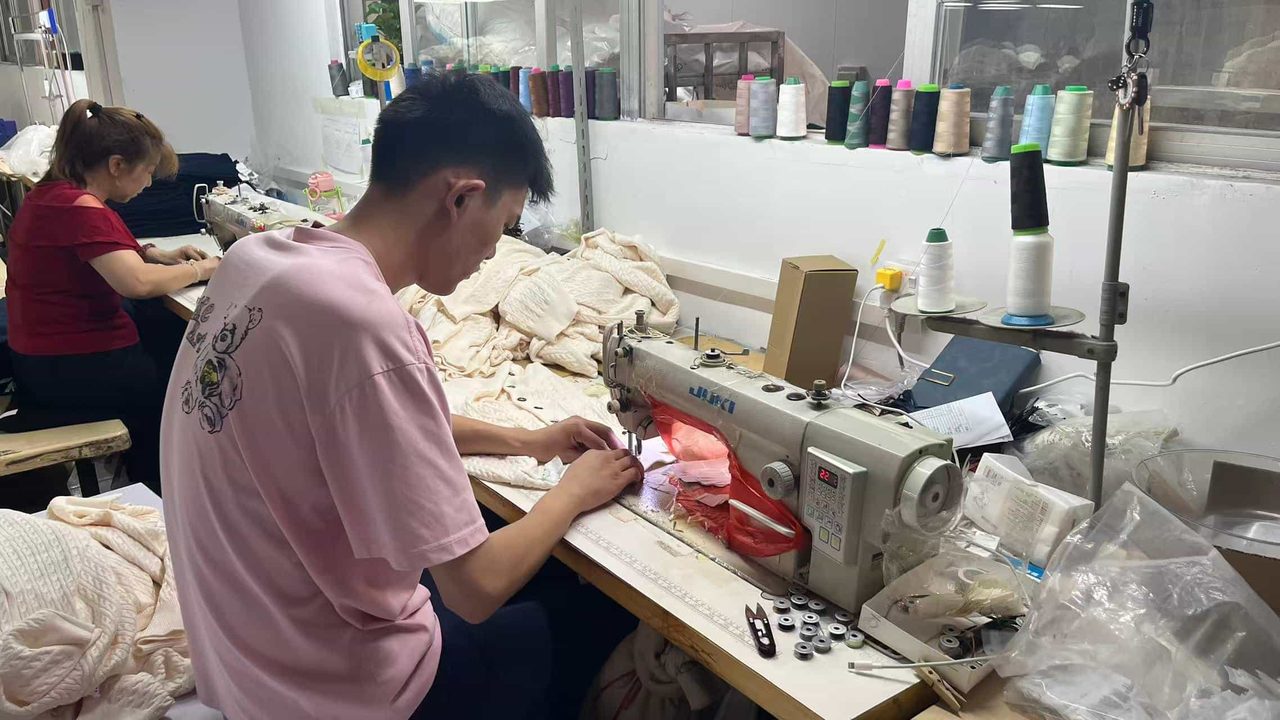
We run 120-plus flat knitting machines covering 3GG to 16GG, with knitting, linking, sewing, pressing and packing under one roof. Because all four shoulders are fully-fashioned knitwear, the choice between them is a design and cost decision for your style — not a question of whether we can make it.
Five shoulder mistakes we see in first enquiries
Do not let the shoulder type be assumed
- Sending a set-in reference and writing “raglan”. They are different programmes and different seams; the sample will not match the photo.
- Leaving the sleeve cap height out of a set-in spec. The cap height is what makes the shoulder fit. Without it, the linker guesses, and puckering is the result.
- Assuming drop shoulder is always cheaper. It usually is, because the sleeve is simpler, but a deep drop uses more fabric, which can erase the saving.
- Specifying a saddle as a raglan. A saddle carries a shaped shoulder piece a raglan does not; the two look alike in a flat photo and knit very differently.
- Stating the silhouette but not the construction. “Relaxed fit” does not tell a knitwear manufacturer whether the seam drops two centimetres or ten.
The sampling article explains what happens after the construction is fixed, including why the first run of a new shoulder behaves differently from the reference.
A shoulder selection card
Use this to turn a vague brief into a buildable spec. Read across, then write the shoulder type and its one key measurement into your enquiry.
| If the style is… | Body complexity | Weight / hand-feel | Recommended shoulder |
|---|---|---|---|
| Tailored, dressy, structured | Higher | Fine to mid-gauge, clean | Set-in (state cap height) |
| Casual, colour-blocked, childrenswear | Lower | Any | Raglan (state seam side) |
| Oversized, unisex, relaxed | Lower | Heavier, drapier | Drop shoulder (state drop in cm) |
| Heritage, cricket, stripe on shoulder | Higher | Mid-gauge, structured | Saddle (state saddle width) |
Four fields that lock the shoulder
- Shoulder type: raglan, set-in, drop shoulder, or saddle — name it, do not describe the look.
- The one key measure: cap height (set-in), seam side (raglan), drop in cm (drop), saddle width (saddle).
- Sleeve length: short, elbow, full — it changes the sleeve programme.
- Gauge: 12GG, 14GG, and so on; it decides stitch count at the armhole.
If you are unsure which shoulder your reference is, send the photo. We will name the construction before we quote, the same way we do for sweater vs sweatshirt and MOQ.
What we make, and what we do not
We are a knitwear manufacturer in Dalang, Dongguan: 120-plus flat knitting machines, 3GG to 16GG, around 1.6 million pieces a year, with knitting, linking, sewing, pressing and packing under one roof. Samples start from one piece, bulk from 50 pieces per style per colour, with bulk lead time of 20–25 days. We make custom made sweaters, pullovers, cardigans, dresses and knitted sets in all four shoulder constructions.
We do not make cut-and-sewn fleece sweatshirts or hoodies; that is a different supply chain, covered in our sweater vs sweatshirt piece. Within knitwear, the shoulder type is a choice we can make with you, not a limit on the order. If your reference is a knit, the next articles that usually help are our cardigan spec sheet and the MOQ breakdown.
There is no shame in writing “I am not sure which shoulder this is”. There is a cost in writing a confident wrong one.
The difference between sweater and sweatshirt decides the factory; the shoulder type decides the programme. Settle both before the first sample.
Frequently asked questions
What is a raglan sleeve?
A raglan sleeve is knitted as one piece with the body, with a single diagonal seam running from the neckline to the underarm on each side. There is no separate sleeve cap to set in, which makes raglan simpler to link than a set-in and a natural choice for colour-blocked or casual knits.
Raglan vs set-in: which one costs more?
Set-in usually costs more, because a shaped sleeve cap is joined to a curved armhole stitch by stitch on the linking machine. Raglan avoids that operation. Drop shoulder is often the cheapest, and saddle the most expensive because of the extra shaped pieces.
What is a drop shoulder sweater?
A drop shoulder sweater places the sleeve seam below the natural shoulder point, with a wider body and a simpler sleeve. It reads as relaxed or oversized. The drop is a measured dimension in centimetres; too little looks like an error, too much bags under the arm.
Is a saddle shoulder the same as a raglan?
No. A saddle keeps a set-in sleeve but adds a shaped shoulder piece across the top, between the neckline and the sleeve. It looks similar to a raglan in a flat photo but knits as a separate part with its own linking, and it is the construction behind most cricket and heritage knits.
Can a sweater manufacturer make all four shoulder types?
A fully-fashioned knitwear manufacturer can. Raglan, set-in, drop shoulder and saddle are four programmes on the same flat knitting machines, finished by linking and pressing. The choice is a design and cost decision for the style, not a question of capability.
Does the shoulder type change the lead time?
It changes the finishing time more than the knitting time. A set-in or saddle needs more linking than a raglan or drop shoulder, so for the same quantity the tailored shoulders can add time at the finishing stage. Bulk lead time stays in the 20–25 day range we quote for knitwear.
Not sure which shoulder your reference is?
Send us the photograph and, if you have it, the one key measure (cap height, drop, or saddle width). We will name the construction before we quote, and we will not quote a shoulder we cannot match to your reference.
Sources
- United States, fibre content and labelling rules for textile products: 16 CFR Part 303, Rules and Regulations under the Textile Fiber Products Identification Act.
- The statute behind those rules: 15 U.S.C. §70 et seq., Textile Products Identification Act.
- European Union, textile fibre names and the labelling of fibre composition: Regulation (EU) No 1007/2011.
- Our own published figures: 120-plus flat knitting machines, 3GG to 16GG, MOQ 50 pcs per style per colour, samples from one piece, bulk 20–25 days.