Sweater Neckline Types: Crew, V, Turtleneck, Boat & Cowl

A neckline is not a styling footnote. It is a knitting decision — how the rib is set, where the front is narrowed, and whether a band is linked or folded on. Here is how a flat-knitting workshop actually shapes each one, and what it changes on your order.

“We want a crew neck, but make it look expensive.” — a brief we got last season. The word crew already sets the rib; “expensive” is a finishing job, not a different neckline.
When a buyer asks for a neckline by name, the cost and lead time of that sweater neckline are already decided by how we knit it, not by how it looks in a catalogue. On a flat machine the neckline is a shaped edge of the fabric: it is either ribbed and rolled, narrowed row by row, doubled into a tube, or linked on as a separate piece. The name tells the workshop which of those four jobs to run.
It matters to a buyer because the wrong assumption quietly adds a linking step, a cone of yarn, or a gauge limit you did not plan for. This piece is written from the knitting floor, so the comparisons below are about ribs, decreases and bands, not about which neckline photographs better.
A crew neck and a V-neck run on the same machines. The difference is a few dozen narrowed stitches and one linked band.
The neckline is a construction choice made before the body is finished, the same way the shoulder type is set at the armhole.
- Crew, V, turtleneck, boat and cowl cover 95% of the neckline enquiries we receive. Each is one of four knitting jobs, not four separate garments.
- Ribbing is the workhorse. A 1×1 or 2×2 rib, doubled and linked, gives a crew or boat its edge; a V is the same rib narrowed at the front.
- Turtleneck and cowl add yarn, not just shaping. A turtle is an 18–22 cm band folded double; a cowl is more fabric left to drape. Both need a finer yarn or a relaxed gauge.
- The neckline caps your gauge. A clean 2×2 rib band reads best at 12GG and above; a bulky 3GG body will not turn a neat turtle.
Name the neckline in the tech pack with a band width in mm, and the workshop matches the rib to the gauge instead of guessing.
The five neckline names buyers actually use
The five sweater neckline names below are the ones we are asked for week after week. They are listed by how the edge is built, because that is what changes the cost. A cotton-trim crew and a wool turtleneck share almost nothing in the knitting, even though both are “just a neckline” to the buyer.
| Neckline | How the edge is built | Sits where | Extra step | Reads best at |
|---|---|---|---|---|
| Crew | Ribbed band, doubled and linked | Base of the neck | Link the band | Any gauge |
| V-neck | Front narrowed, V-band linked | Centre front | Decrease + link | 7GG and above |
| Turtleneck | Long rib doubled into a tube | Folds at the throat | Extra length + fold | 12GG and above |
| Boat | Wide shallow rib near the shoulder | Close to the collarbone | Widen the shoulder | 5GG and above |
| Cowl | Loose ring of fabric, draped | Falls below the chin | More fabric, no fold | 7GG and above |
How each neckline is shaped on the machine
Every sweater neckline in this guide is one of four knitting jobs. Learn the four jobs and you can read any neckline brief, including the ones we have not listed.
Ribbed and rolled — crew and boat
The simplest edge is a ribbed band. We knit a 1×1 or 2×2 rib, usually 2–4 cm wide, then link it to the body on the linking machine. A crew is a round band sitting at the base of the neck; a boat is the same idea widened toward the shoulders so the opening runs almost to the collarbone. The boat needs the shoulder line widened by a few centimetres, which is a programming change, not a new machine.
Narrowed and fashioned — V-neck
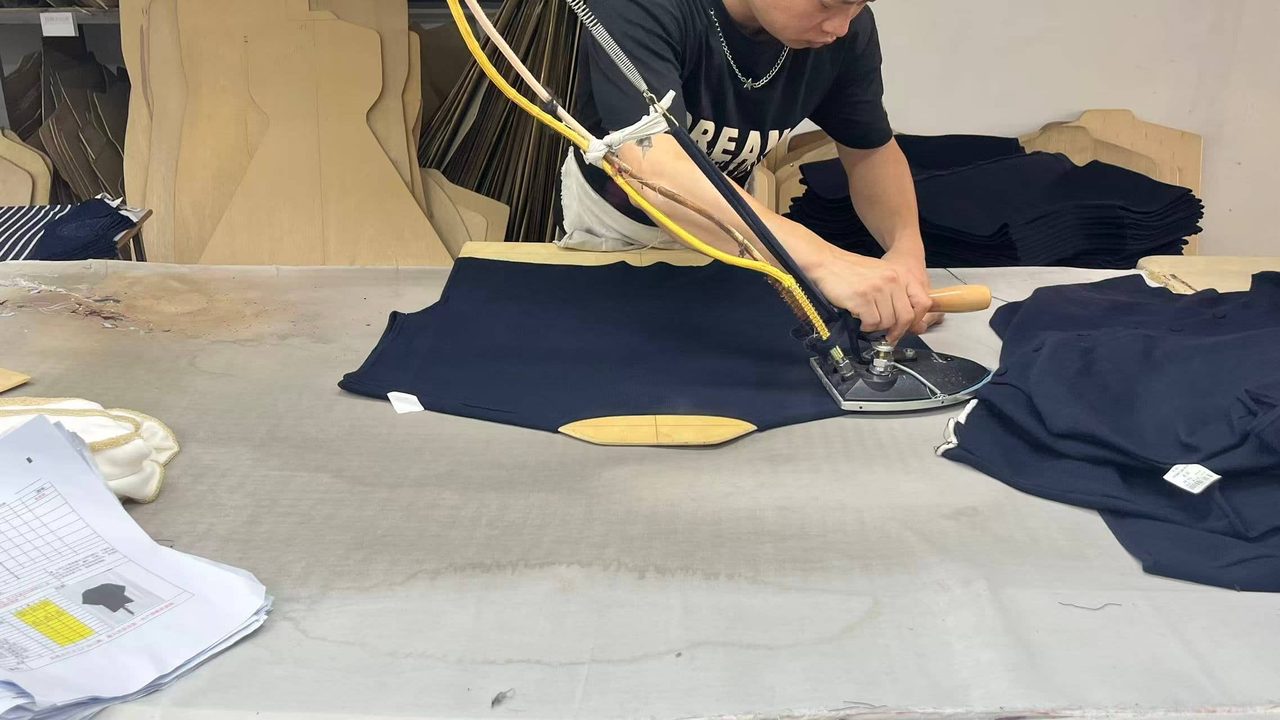
A V-neck is a crew with the front narrowed. On each side of centre front we decrease roughly one stitch every two rows so the fabric draws down to a point. A separate V-band — a short rib strip — is then linked into the V so the edge does not curl. That linking step is why a V costs a little more than a crew of the same yarn, and why a sloppy V means a misaligned band.
Doubled into a tube — turtleneck and cowl
A turtleneck is the one neckline that adds yarn rather than just shaping. We knit an extra 18–22 cm of rib at the neck, then fold it double and link the fold, so the throat is wrapped in two layers. A cowl skips the fold: the same extra length is left loose so it drapes below the chin. Both need a finer yarn or a relaxed gauge, because a thick tube at the neck will not turn and will stand away from the body.
Linked as a separate trim — polo, mandarin, cardigan placket
Any standing or open neckline — a polo collar, a mandarin band, a cardigan front — is knit as its own piece and linked on. This is the linking step covered in our shoulder-type piece, applied to the front edge instead of the armhole. It is the most labour-intensive neckline option, but it is also the only way to get a collar that stands or a front that buttons.
Ribbing, linking and pressing: where necklines go wrong
A sweater neckline is the most-handled edge on the garment, so it is where small workshop errors show first. The defects below are the ones we check at finishing, and the ones a buyer should check on a first sample.
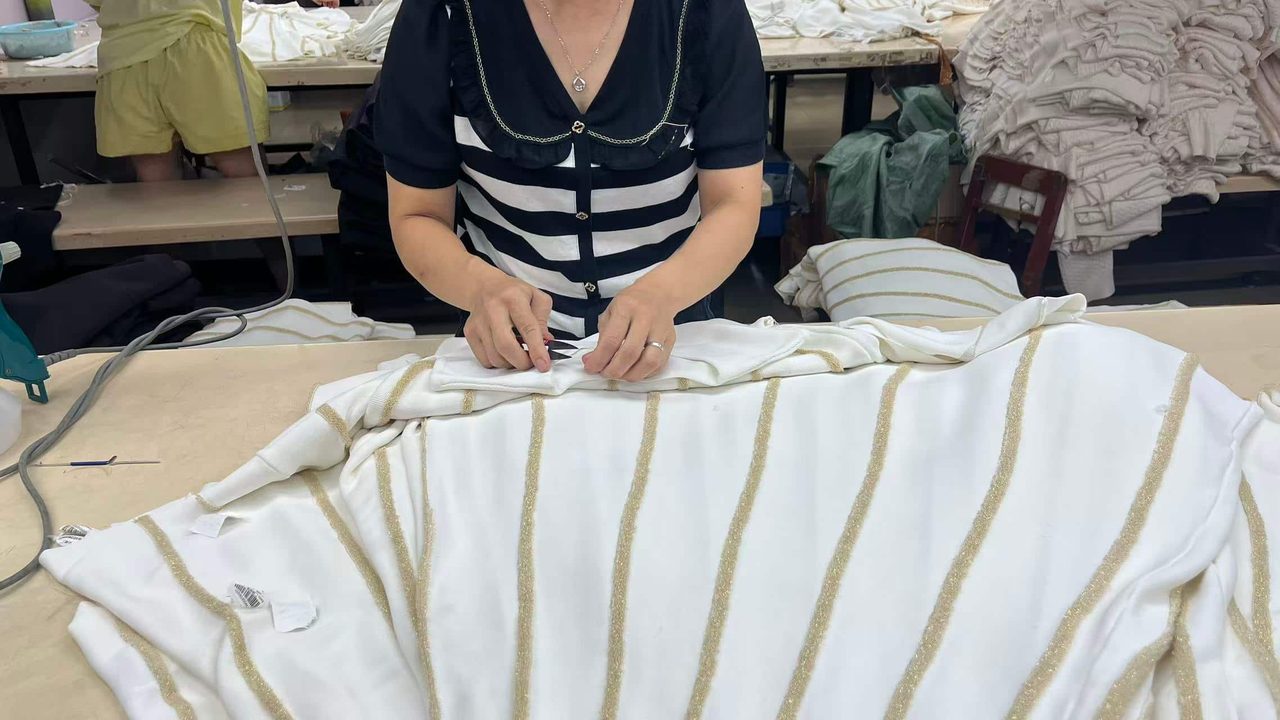
- Uneven rib tension — one side of the band tighter than the other. Caught at pressing; fixed by re-setting the rib tension, not by re-knitting the body.
- Misaligned V — the linked V-band sits off-centre. A measuring jig at linking keeps it within 2 mm; without it, every piece drifts.
- Puckered turtle — the doubled tube pulls. Almost always a gauge-and-yarn mismatch: the band is too thick for the body gauge.
- Stretched boat — the wide edge grows during wear. A stable shoulder line and a firmer rib hold it; a loose 1×1 does not.
A neckline spec sheet for your tech pack
The fastest way to get the neckline you pictured is to send five fields with the style. We turn these into the knitting programme directly, the same way we turn a sampling request into a first sample.
Five fields that lock a neckline
- Type by name — crew, V, turtleneck, boat or cowl. If you mean a hybrid, send the reference photo.
- Band width in millimetres — 20–40 mm for a crew, 180–220 mm of length for a turtle. Numbers, not “standard”.
- Rib structure — 1×1 or 2×2, and whether it is doubled.
- Link or fold — does the band stand, roll, or fold? This decides the linking step.
- Tolerance — how much the band may vary at the centre point, usually ±2 mm.
Write these next to the gauge and the yarn on the same page. The neckline, the gauge and the yarn are read together, not separately.
When a neckline limits your gauge or yarn
A sweater neckline can also cap your gauge choice, and buyers are surprised by this more than by any cost. A neat 2×2 rib band needs enough needles per centimetre to read as a rib; at a coarse 3GG–5GG the same band looks like a rolled edge, not a rib. A turtleneck needs a finer yarn or a relaxed gauge so the doubled tube turns and lies flat.
Our range is 3GG to 16GG, around 120-plus flat knitting machines, with bulk lead time of 20–25 days from yarn-in to packed. At 12GG and above the neckline bands read clean and a turtle behaves; below 7GG we steer buyers toward a boat or a rolled crew, which look right at coarse gauge and avoid a band that will not turn. This is a knitting constraint, not a preference, and naming it early saves a rejected first sample.
Neckline and the fibre label
A sweater neckline does not change the fibre-content rules, but a blended band can. If the body is wool and the rib is a wool–nylon mix for recovery, both compositions must be stated where they differ. In the US, textile fibre content is governed by the Textile Fiber Products Identification Act and its rules at 16 CFR Part 303; in the EU, fibre names and labelling fall under Regulation (EU) No 1007/2011. We state the composition of the body and any contrasting band separately, the same way we handle it across low-MOQ runs and large orders.
What we make, and what we do not
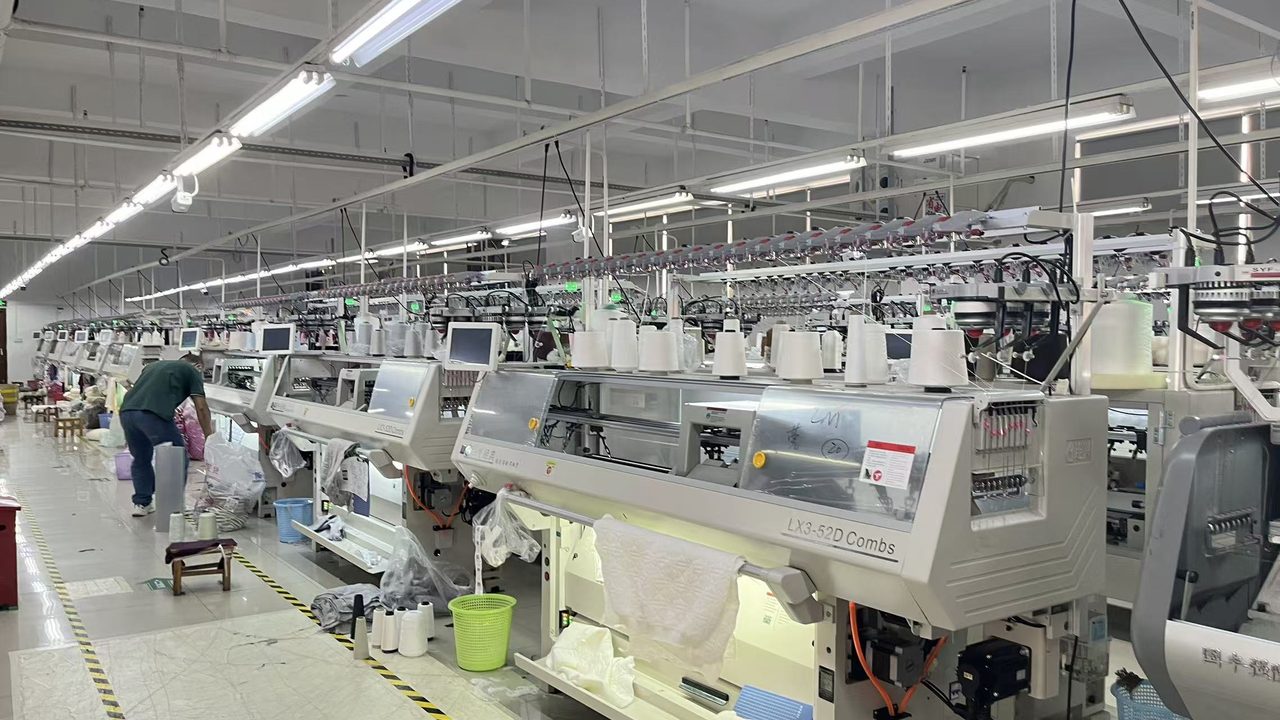
We are a knitwear manufacturer in Dalang, Dongguan: 120-plus flat knitting machines, 3GG to 16GG, around 1.6 million pieces a year, with knitting, linking, sewing, pressing and packing under one roof. Samples start from one piece, bulk from 50 pieces per style per colour. We produce all five necklines in this guide — crew through cowl — plus polo and mandarin collars and cardigan plackets, on pullovers, cardigans and knitted sets.
We do not make cut-and-sewn fleece sweatshirts or hoodies; that is a different supply chain, covered in our sweater vs sweatshirt piece. Within knitwear, the neckline is a choice we make with you from the tech pack, not a limit on the order. If your reference is a knit, the reads that usually help next are our cardigan spec sheet and the MOQ breakdown.
Frequently asked questions
What are the most common sweater neckline types?
These five necklines cover the large majority of knitwear enquiries. Crew and boat are ribbed and rolled, V is narrowed at the front, and turtleneck and cowl are doubled or draped tubes. Each is a different knitting job, not a different garment.
Is a V-neck harder to make than a crew neck?
Slightly. A V needs the front narrowed row by row and a separate V-band linked in, so it adds a linking step and a little set-up. On the same yarn and gauge a V typically costs a touch more than a crew but uses the same machines.
Can a turtleneck be made at any gauge?
In theory, but not well. A turtleneck is a doubled 18–22 cm band, and a thick yarn at coarse gauge will not turn or lie flat. We steer turtlenecks to 12GG and above, or to a finer blended yarn, so the tube folds cleanly.
Does the neckline change the minimum order?
No. Our MOQ is 50 pieces per style per colour, samples from one piece, whether the neckline is a crew or a turtleneck. The neckline changes the programme and the yarn plan, not the order minimum.
Why does my V-neck band look off-centre?
Almost always a linking tolerance issue, not a pattern error. The V-band must be linked to a measured centre point within about 2 mm; without a jig, pieces drift. It is caught and corrected at finishing, before packing.
Do I need to specify the rib structure?
Yes, if the look matters. A 1×1 rib is finer and flatter; a 2×2 is chunkier and springs back harder. Write 1×1 or 2×2 and the band width in mm, and the workshop sets the rib against the gauge instead of guessing.
Five fields that lock a neckline
Send these with the style and we will size the rib to the gauge before sampling: (1) the neckline by name, (2) band width in mm, (3) rib structure 1×1 or 2×2, (4) link or fold, (5) tolerance. We will not guess a band we cannot match to your reference.
Sources
- United States, fibre content and labelling of textile products: 16 CFR Part 303, Rules and Regulations under the Textile Fiber Products Identification Act.
- United States statute behind the labelling rule: 15 U.S.C. § 70, Textile Fiber Products Identification Act.
- European Union, textile fibre names and fibre composition labelling: Regulation (EU) No 1007/2011.
- Our own published figures: 120-plus flat knitting machines, 3GG to 16GG, MOQ 50 pcs per style per colour, samples from one piece, bulk 20–25 days.