Cotton vs Wool Sweaters: A Sourcing Guide for Brands
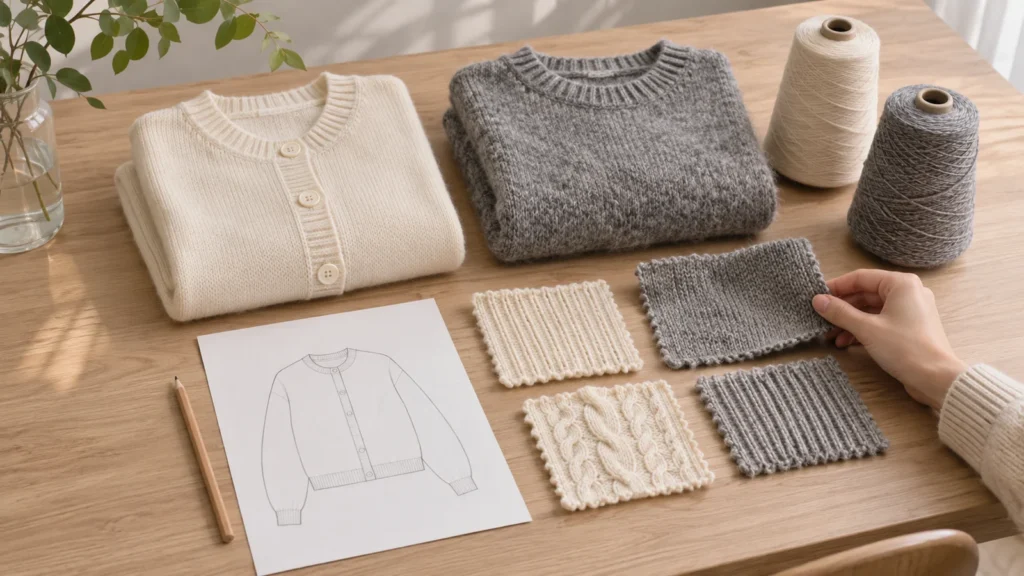
Choose cotton for a smooth, substantial everyday knit or a lighter-season cardigan. Choose wool for a loftier winter sweater where warmth and springy recovery matter. Choose fine Merino wool for a soft, fine-gauge layer worn next to the skin. Merino is a type of sheep’s wool; its name alone does not specify fibre diameter or garment weight.
Match that starting choice to the construction. A heavy cotton cable sweater and a lightweight Merino cardigan serve different jobs. Set the target hand, warmth, drape and care instructions first, then select a yarn and finished sample that deliver them.
Three product briefs: what to choose and what to order
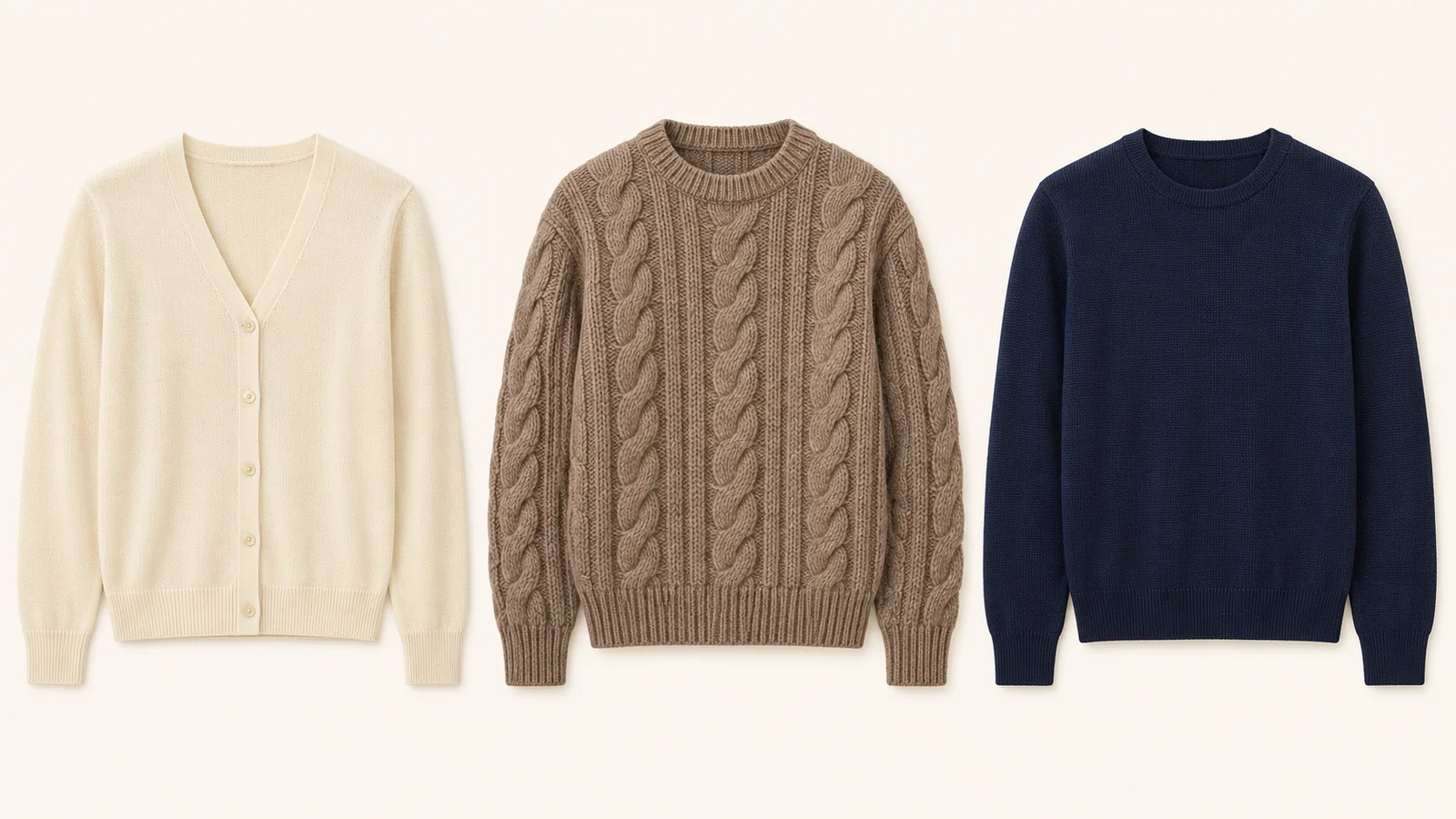
AI-generated garment concepts: a lightweight cardigan, winter cable pullover and fine-gauge layer. These illustrate product briefs, not Liming samples or measured material performance.
A lightweight cardigan for spring and indoor layering
Start with cotton for a clean, smooth-looking cardigan with a substantial hand. Keep the yarn and knit light enough for the brief: a dense, heavy cotton fabric will not become a summer layer simply because it is cotton. Sample fine Merino instead when a softer, springier handle is the priority.
Order a finished sample with a target garment weight, stitch reference and base-size measurements. Review the button placket, hem and hanging length after the intended wash and drying process. If the front grows or twists, adjust the yarn, stitch settings or finishing before approving bulk production.
A winter cable pullover
Start with wool for a loftier, insulating sweater. Wool’s crimp helps create bulk and trapped air. Yarn preparation, cable structure and finished thickness determine how warm and heavy the garment becomes. A cotton version suits a more substantial, weighty interpretation and needs its own construction and quotation.
Send a cable-definition reference and target finished weight. Request a finished swatch or garment in the proposed yarn, then review cable clarity, surface appearance and dimensions after care. Include the neckline and ribs in approval so their recovery supports the body.
A fine-gauge pullover worn against the skin
Start with a specified fine Merino yarn when softness and elastic recovery lead the brief. Finer wool fibres bend more readily against the skin than coarse fibres. For a smoother, less lofty cotton feel, develop a specified cotton yarn in parallel. Both can make fine-looking knits; count, stitch density and finishing determine the result.
For Merino, request mean fibre diameter and available coarse-fibre information, not just “premium wool.” Compare finished necklines and cuffs against the skin, and assess opacity, drape and recovery on the garment. Approve its care label with the sample. Woolmark explains the relationship between diameter and prickle in its softness guidance.
Cotton vs wool at a glance
On a small screen, swipe the table sideways to compare all columns.
| Decision point | Cotton | Wool—including Merino |
|---|---|---|
| Feel and surface | A smooth, low-halo cotton yarn suits clean, casual knitwear. A soft or dry hand depends on fibre quality, spinning, twist and finishing; cotton can also have a hairy surface. | Fine Merino suits soft, next-to-skin knits; coarser wool fibres can feel prickly. Specify fineness and the finished surface rather than treating all wool as equally soft. |
| Warmth and breathability | An open, lightweight cotton knit suits lighter-season layering. A dense, heavy construction gives more body and can be warm; thickness and openness matter more than a “summer cotton” label. | Wool’s crimp supports loft and insulating air, making wool a strong starting point for winter sweaters. Fine, lightweight wool can also make a light layer. Airflow and vapour transfer depend on construction. |
| Appearance and drape | Cotton can give a clean, weighty hang and visible stitch definition. Long or loose knits need attention to hanging growth; count, ply and stitch density control the silhouette. | Wool’s resilience suits springier shapes, while loftier yarns soften the outline. Compact yarn and finishing can create a cleaner surface. Match these choices to the intended cable definition or drape. |
| Care | Cotton knits can shrink, skew or grow as loops relax during processing and laundering. Finishing tension, relaxation and the specified wash/dry process influence the result. | Untreated wool can felt under unsuitable washing. Shrink-resist treatment changes care options, but “Merino” alone does not mean machine washable. The finished garment must support its care label. |
| Pilling and fuzz | Cotton can pill or fuzz. Fibre dimensions, yarn construction and finishing affect the surface; a smooth new sample does not establish durability after wear. | Soft, hairy wool finishes trade a crisp surface for a loftier look and can develop fuzz or pills. Blend, yarn structure and finishing affect surface wear; fine Merino is not inherently pill-free. |
| Fit and recovery | Cotton-knit dimensions depend strongly on loop geometry and processing. Check length, width and placket shape after care and hanging, particularly in loose constructions. | Wool has useful elastic resilience, but relaxation and felting can still change fit. Assess ribs, linked seams and body panels together. |
The physical basis for wool crimp, fineness and resilience is described in Woolmark’s fibre explanation. CottonWorks’ shrinkage guidance and durability guidance explain how construction and processing affect dimensions and pilling. These industry technical sources inform the product recommendations above.
Why the same fibre can produce a different sweater
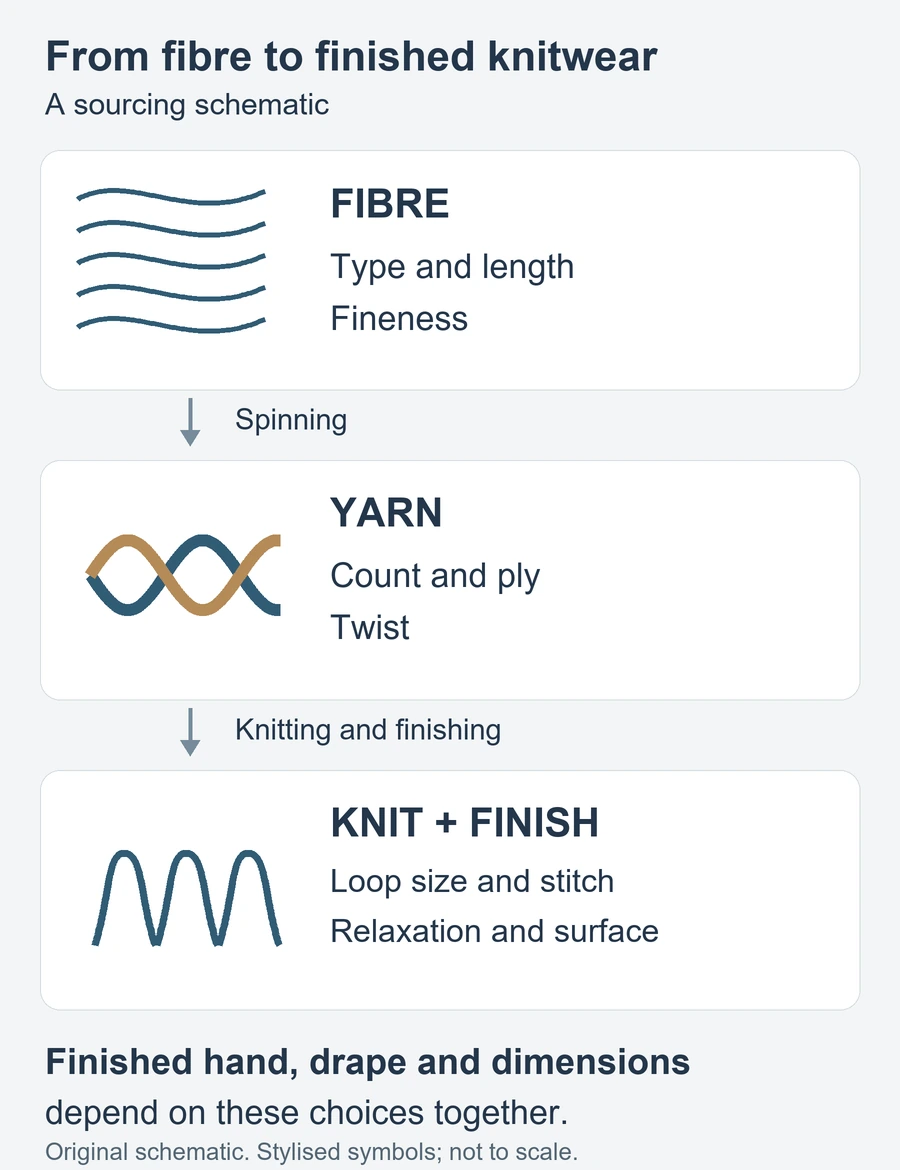
Original editorial schematic, drawn for this guide. Stylised symbols, not a microscopic view or scale drawing. Technical basis: CottonWorks construction guidance and Woolmark fibre explanation. No third-party diagram is reproduced.
Specify fibre, yarn, knit construction and finishing together. A fibre name describes the starting material. Yarn count and ply affect the strand used to make the loops; twist and surface treatment alter handle and appearance. Stitch structure, loop size and finished weight affect how the yarn becomes fabric. Relaxation, washing, pressing and other finishing steps then change the sample you approve.
For a cardigan, include rib, placket and button specifications because they influence how the front hangs. Gauge alone does not describe tightness or weight: record stitch settings or density and finished mass as well. CottonWorks identifies these variables as important controls on dimensional change.
Use two different sample briefs for two different questions:
- To compare materials: keep construction and finished dimensions as comparable as practical, and record remaining differences. This helps identify what changed with the candidate yarns.
- To choose a saleable product: allow each material an appropriate construction, then compare complete garments for fit, hand, appearance, care and total cost.
Merino vs cotton: make recovery part of approval
Include a recovery check for a fitted neckline, ribbed cuff or longer garment. Wool’s resilience is a useful reason to shortlist Merino, but the buying decision concerns the finished knit and its seams.
In Scott and colleagues’ 2026 cotton and Merino single-jersey study, the Merino specimens recovered better than the cotton specimens under the study’s specified relaxation and loading treatments. Linked seams and adjacent fabric behaved differently. The authors’ university record identifies the publication.
Use that finding to plan the sample check, not to assign a recovery percentage to a different cable, rib, yarn or cardigan. Give the supplier the required fit and recovery period, and examine the assembled garment after treatment. Record Merino fineness, count, ply and shrink-resist treatment; identify the actual cotton yarn and finish rather than approving an unspecified substitute.
Send a brief that produces comparable quotations
Send the same product requirements to each supplier, while allowing them to identify necessary construction changes. This makes the quotation useful without forcing two yarns into an unsuitable specification.
- Exact composition and yarn reference; count and count system; ply and twist information; relevant fibre-quality details. Identify substitutions separately.
- Intended stitch, gauge, finished weight and dimensions, with a surface and drape reference. Record construction changes between candidates.
- Sample condition: finished or unfinished, washed or unwashed, relaxation history, and whether it represents the proposed bulk construction.
- Proposed care instructions and acceptance criteria, plus responsibility and cost for laboratory work.
- Equivalent quotation scope: quantities by design, colour and size; yarn commitments; samples; finishing; labels; packaging and delivery terms.
Compare complete quotations rather than applying a fixed cotton-versus-Merino premium. Use the tech pack checklist to record the selected specification and the sampling guide for approval workflow. The supplier comparison explains the purchasing models behind different offers.
Agree a focused test plan
Start with fit after care, surface appearance and recovery. Add thermal or air-permeability measurements when a specific product claim requires them. “Breathable” should name the property being assessed: airflow, vapour transfer and drying behaviour are different questions.
On a small screen, swipe the table sideways to compare all columns.
| Approval question | Relevant method or assessment | Define before testing |
|---|---|---|
| Does fit survive the intended care? | ISO 6330:2021 washing/drying procedures with ISO 5077:2007 dimensional-change measurement. | Procedure, drying method, cycles, conditioning, measurement points and tolerances. |
| Is surface appearance acceptable? | An appropriate pilling method, such as ISO 12945-2:2020. | Method and edition, exposure, sample treatment, assessment conditions and acceptance level. |
| Do ribs and garment recover? | A laboratory-agreed growth/recovery assessment and garment fit review. | Load or extension, direction, hold/recovery time and treatment history. |
| Does a performance claim need evidence? | ISO 11092:2026 for thermal/water-vapour resistance; ISO 9237:1995 for air permeability. | Precise claim, specimen construction, conditions and interpretation. |
How to use the evidence: methods describe how properties are assessed, not a universal pass level. Research findings apply to their specimens and conditions; ISO 11092’s steady-state conditions do not represent every wearing situation. This guide contains no Liming comparison-test results, fixed shrinkage rates or pilling grades. Agree product-specific limits and support performance claims with evidence from the approved construction.
Discuss Your Knitwear Project
Use the pullover sweater and knit cardigan categories as style references. Existing styles can be selected for quotations and repeat orders; garments are produced after an order is received. Send the style reference, intended composition, colours, quantities for each size and required delivery date. Yarn availability, specific finishes and testing arrangements are project-specific quotation items.
MOQ: 50 pcs per design, per color, per size. Different sizes cannot be combined to reach 50 pieces. Sampling takes 3 days and bulk production takes 15–25 days; confirm the project scope and schedule in the quotation.
Technical sources checked on 11–12 November 2026. Cover and product-scenario image: AI-generated editorial concepts, not photographs of Liming’s facilities, samples or identified yarn stock. Principle diagram: original code-drawn schematic based on the linked technical explanations.
