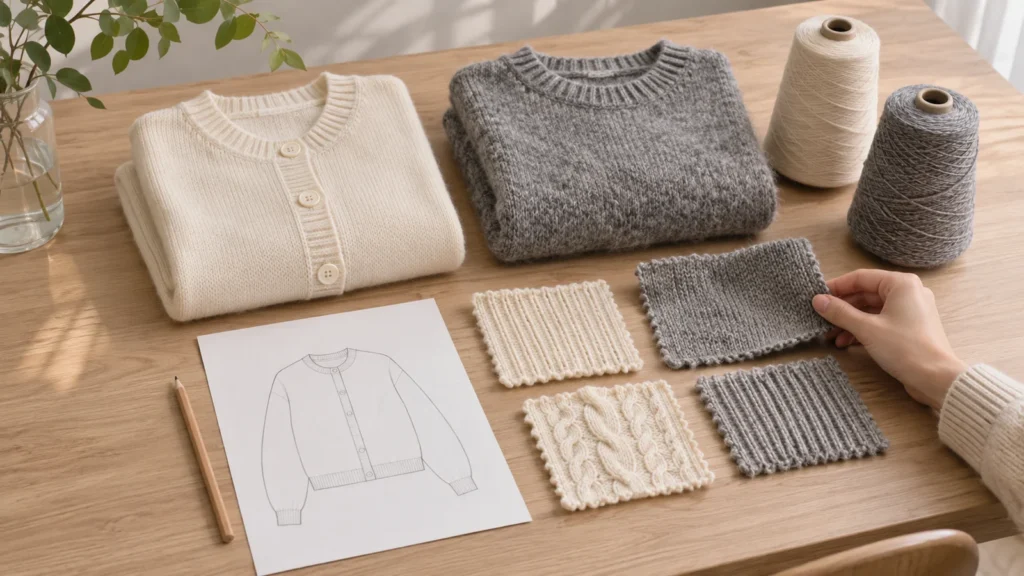
Custom Sweater Manufacturer: Cotton vs Wool Yarn

Ask a buyer to choose between cotton and wool and you get an answer about feel. Ask a factory and you get four answers about yarn, machines, finishing and labels. Both are right; only one can be quoted.

Two buyers can both say “I want something warm and soft” and order two garments that no factory could price from the same line.
As a custom sweater manufacturer, I hear the cotton vs wool sweater question framed as a matter of taste. It is not, or not only. Cotton and wool arrive at our floor as different yarns, run at different counts, behave differently under the press, and end up with different words on the care label. Pick the fibre and you have quietly picked four production decisions.
This page is not a style guide. It is the factory side of a cotton or wool sweater decision: what each fibre locks in, where the cost lands, and how to choose before a quote rather than after a sample. If you are comparing a cotton sweater vs wool for a first order, read the four constraints in order.
Cotton and wool are not two versions of the same blank. They are two starting points that carry different rules all the way to the label.
Zhao Sheng, on choosing the fibre first
- Fibre sets four constraints. Yarn count, workable gauge, finishing route and care wording. Change the fibre and all four move.
- Cotton is stable but heavy. It holds shape and colour well, takes a higher gauge, and reads as a lighter, cooler garment with less loft.
- Wool is forgiving but needs control. It gives loft and warmth at a lower gauge, but shrinking and hand feel must be managed in finishing.
- Merino is a wool decision, not a third category. It changes fineness and price, not the four constraints above.
- Our published line: 120+ flat knitting machines, 3GG–16GG, about 1,600,000 pieces a year, 5,000 m² floor, MOQ 50 pieces per style per colour, samples 3–7 days, bulk 20–25 days.
Fibre is four production constraints, not a feeling
A buyer says “soft” and pictures the garment. A factory hears a request that has to be translated into a yarn order and a machine setting. Cotton and wool answer that request differently in four places. None of the four is visible in a photo, and all four appear on the cost sheet.
| Constraint | Cotton route | Wool route |
|---|---|---|
| Yarn count | Spun cotton counts chosen for smoothness and weight per piece | Worsted or woollen counts chosen for loft and warmth |
| Workable gauge | Holds a finer, tighter fabric at higher gauges | Usually sits coarser; loft comes from the fibre, not the needle count |
| Finishing | Stable in wash; pressing sets the shape | Controlled wash and board are needed to fix size and hand feel |
| Care wording | Care label is straightforward for a knit of this type | Fibre content and wool care claims must be precise and evidenced |
Four lines, four cost effects. This is what a wool vs cotton sweater comparison looks like on a factory desk.
The point is not that one fibre is better. It is that a spec naming only “knitted sweater, soft” leaves a factory to choose a route on the buyer’s behalf. That choice is then baked into the yarn order, the machine programme and the label long before anyone sees a sample.
Choosing the fibre from the handle of a swatch alone. A swatch tells you the hand feel today; it does not tell you the size after the first wash or the wording on the care label.
Where cotton and wool separate on the machine
Start with yarn count. Cotton is spun to counts that give a smooth, even face, and it can be taken to a fine gauge without losing definition. Wool carries more loft for the same weight, so a cotton vs merino wool comparison often resolves into a gauge decision: the wool version reaches the same warmth at a coarser needle count.
Gauge is not a prestige number. It changes knitting time, yarn consumption and the way the edge behaves. A fine-gauge cotton piece and a mid-gauge wool piece can look similar on a hanger and be priced by entirely different rules. This is the same discipline we apply when writing a spec for a custom knit sweater: the needle count is named, not implied.

Ask which gauge a fibre needs and you learn what the garment costs to knit. Ask only how it feels and you learn nothing a factory can price.
Zhao Sheng, on reading a yarn choice as a machine setting
Merino deserves one clarification. It is wool, not a third material category. It changes the fineness of the fibre and therefore the price and the hand feel, but it does not remove the four constraints. A merino vs cotton decision still ends at the same finishing and care-label questions.
The wash, the board and the size you actually ship
The largest practical difference between the two fibres appears after knitting. Cotton is dimensionally stable in a normal wash; pressing sets the shape and the panel largely stays where you put it. Wool has memory and movement. It must be washed and boarded under control, or the size on the label will not be the size in the carton.
That is why a cotton sweater vs wool question cannot be settled by looking at the dry sample. Ask what happens after the first wash. A buyer who approves a wool sample without seeing the finished dimensions is approving a garment the bulk may not reproduce. Our note on how a first sample is built sets out why approval follows the finishing route, not the look.
Wool that is over-finished feels dense and loses loft; wool that is under-finished changes size in the customer’s wash. The finishing window is narrow, and it is a real cost on the sheet.
Colour belongs here too. Cotton takes and holds dye predictably across a run, which is useful for a solid programme with several colours. Wool accepts colour differently and the same dyelot must be held across the pieces that will be sold together. This is a lot-control question, not a style preference.
Choosing the fibre from the order, not the moodboard
Work backwards from what the garment has to do. The table below is the shape we use in a first conversation. It does not rank the fibres; it matches them to an order profile.
| If the order needs… | Start with | Because |
|---|---|---|
| Fine gauge, clean colour, easy care | Cotton | Stable in wash, holds a smooth face at higher gauges |
| Loft and warmth at a moderate gauge | Wool | The fibre gives volume without a very fine needle count |
| Softness against skin at a premium price | Merino wool | Finer fibre; still a wool finishing and care route |
| Several colours in one consistent run | Cotton | Dye and lot control are easier to hold across the order |
| A light layer for warmer markets | Cotton | Less loft per gram, cooler hand, simpler care wording |
Our knitted line runs 3GG–16GG with MOQ 50 pieces per style per colour. The gauge window matters as much as the fibre name.
For the label, the fibre name is a declaration, not a description. In the United States, the Textile Fiber Products Identification Act governs how fibre content appears on labels and requires the declared percentages of the fibres present. A blend is not solved by calling it “cotton touch”. Our note on what a certification covers shows the same habit of matching the document to the goods.
Three ways the wrong fibre shows up in the bill
A fibre mistake rarely announces itself in the enquiry. It surfaces in three places, and each one is more expensive than the last.
| Where it shows | What went wrong | What it costs |
|---|---|---|
| The quote | Two factories assumed different fibres from one word | Two unrelated numbers for the same brief |
| The sample | Hand feel approved before the finishing route was fixed | A sample the bulk cannot reproduce in size |
| The label | Fibre content written from memory, not from the yarn order | Relabelling, or a product held at the border |
Import classification follows the fibre and construction, not the marketing name. The importer or broker makes that call; we supply construction and composition.
In the United States tariff schedule, heading 6110 covers knitted or crocheted pullovers; the fibre content still has to be declared correctly under the textile labelling rules. In the EU, the textile labelling regulation sets the fibre names. Legal detail belongs to the importer’s adviser. A factory can keep the composition and construction accurate; it cannot assign the classification for them.
The cheapest moment to fix a fibre decision is before the yarn is ordered. Every stage after that adds the same mistake to a new bill.
Zhao Sheng, on the cost of a late fibre change
Questions buyers ask about cotton and wool
Which is warmer, a cotton or a wool sweater?
Wool gives more loft for the same weight, so a wool sweater usually insulates better at a similar thickness. Cotton can be knitted denser, but it has less natural volume. Warmth is a construction question as well as a fibre question.
Is a cotton sweater less expensive than wool?
Often, but not always. Yarn price is only one input. A fine-gauge cotton piece can take more knitting time than a coarser wool one. Compare the full specification — count, gauge, finishing — before treating one fibre as the cheaper route.
What is the difference between merino and regular wool?
Merino is a finer wool fibre. It feels softer and usually costs more, but it still follows the wool route on the machine, in finishing and on the care label. It is not a separate material category.
Will a wool sweater shrink?
It can, if the finishing route is not controlled. Wool has movement that cotton does not. We wash and board wool pieces to fix the size before approval, and the sample should be checked after that process, not before it.
Can you mix cotton and wool in one sweater?
Yes, as a blend or by placing different yarns in different parts of the garment. A blend must be declared by percentage on the label, and the finishing route has to suit both fibres. Specify the exact ratio before sampling.
Which fibre is better for a cotton vs wool sweater order with several colours?
Cotton is usually easier to hold consistent across a multi-colour run. Wool can be done, but the dyelot has to be controlled across the pieces sold together. State the colour count and the destination market in the first enquiry.
Does the fibre change the minimum order?
Our knitted minimum is 50 pieces per style per colour regardless of fibre. What changes is yarn sourcing: a special wool count may take longer to secure than a stock cotton count. Ask about the yarn before you fix the sample date.
What should I write in the enquiry to get a usable quote?
Name the fibre or the exact blend, the target gauge, the weight per piece, the colour count and the destination market. That is enough to place the order on the right line. A photo of a soft sweater is direction, not a specification.
References
The legal points above are summarized, not quoted as advice. Check the current text with the authority or your importer’s adviser before relying on it.
- 16 CFR 303.1 — Definitions under the Textile Fiber Products Identification Act, Legal Information Institute, Cornell Law School.
- 16 CFR 303.6 — Requirements for fibre content labels, Legal Information Institute, Cornell Law School.
- 15 U.S.C. §70 — Textile Fiber Products Identification Act, Legal Information Institute, Cornell Law School.
- 16 CFR 423.1 — Definitions under the Care Labeling Rule, Legal Information Institute, Cornell Law School.
- Harmonized Tariff Schedule, heading 6110 — knitted or crocheted pullovers, U.S. International Trade Commission.
Name the fibre, not the feeling
Tell us the fibre or blend, the gauge you have in mind and the market you are shipping to. We will tell you which of our lines it belongs on, and what the choice changes in the quote.
WhatsApp / WeChat +86 137 1519 6498sychen@limingknitwear.com
— Zhao Sheng (赵生), Owner, Liming Knitwear · Dalang, Dongguan, China