Sweater Manufacturer vs Knitwear Supplier: 8 Questions

A sweater manufacturer and a knitwear supplier can both quote you the same garment. Only one of them can answer, in one message, how many machines your order will occupy and what happens to the first panels off the bed. Here is the difference, where it costs you money, and eight questions that expose it.
- Both are legitimate. A knitwear supplier sells coordination; a sweater manufacturer sells machine time. Confusing the two is what makes a quote uncheckable.
- The label is not proof of the knitter. U.S. rules let a company that markets or handles the goods put its own name on the label.
- Ask a machine question. Gauge, machine allocation and first-panel waste are answerable in one message only by the party that owns the needle bed.
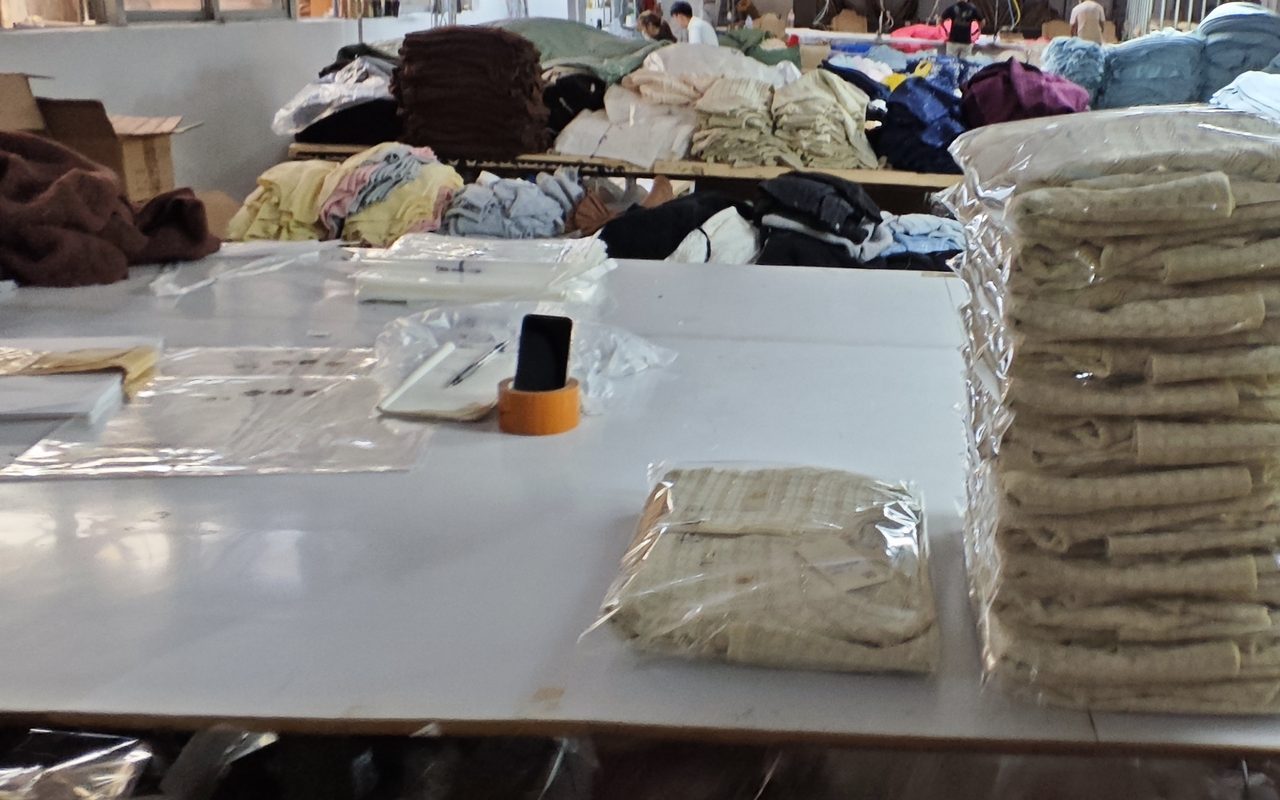
A sweater manufacturer and a knitwear supplier are not two words for the same company. We run 120+ computerized flat knitting machines in one 5,000 m² building in Dalang, Dongguan, so we sit on the manufacturing side of that line.
This article is not an argument that trading companies are bad. It is a way to work out who controls each decision on your order — because the moment you change a gauge, a rib or a delivery date, the answer decides whether you get a revised technical answer or a forwarded email.
Day 0 to day 25: who touches your order
Most buyers see two moments: the purchase order going out and the cartons arriving. Between them, a knitwear order passes through four or five different organisations. Each hand-off is a place where a number can be rounded, a tolerance dropped, or a finish described as “as discussed” instead of written down.
The buyer who knows which party holds each day can forecast a delay before anyone admits one. Our published terms are a one-piece sample in 3–7 days and bulk in 20–25 days after sample approval, with an MOQ of 50 pieces per style per colour. Those numbers are only meaningful because the same building books the machines, links the panels and presses the garment. If any of those steps sits with a third party, the calendar has an owner you have not met.
The name on the label is not the name of the knitter
This is the most common assumption in sourcing, and the easiest to settle with primary sources rather than opinion. U.S. labelling rules do not require the company named on a textile label to be the company that knitted the fabric. They require a responsible party — and that party may be a marketer or handler.
The statute behind the rule says the same thing. 15 U.S.C. § 70b(b)(3) requires “The name, or other identification issued and registered by the Commission, of the manufacturer of the product or one or more persons subject to section 70a of this title with respect to such product” (Legal Information Institute, verbatim).
The implementing rule is blunter still: “The name required by the Act to be used on labels shall be the name under which the person is doing business” (16 CFR § 303.19(a), verbatim). Section 303.2(d) then puts responsibility on “Any person marketing or handling textile fiber products” who causes or directs the labelling.
None of those clauses identifies the knitter. A name on a label is a compliance contact, a brand or a registered number — not a machine address. EU law makes the point even more directly.
Article 15(2) of Regulation (EU) No 1007/2011 states that “A distributor shall be considered a manufacturer for the purposes of this Regulation where he places a product on the market under his name or trademark” (EUR-Lex, verbatim). In law, the word “manufacturer” can describe a company that never touched a needle bed.
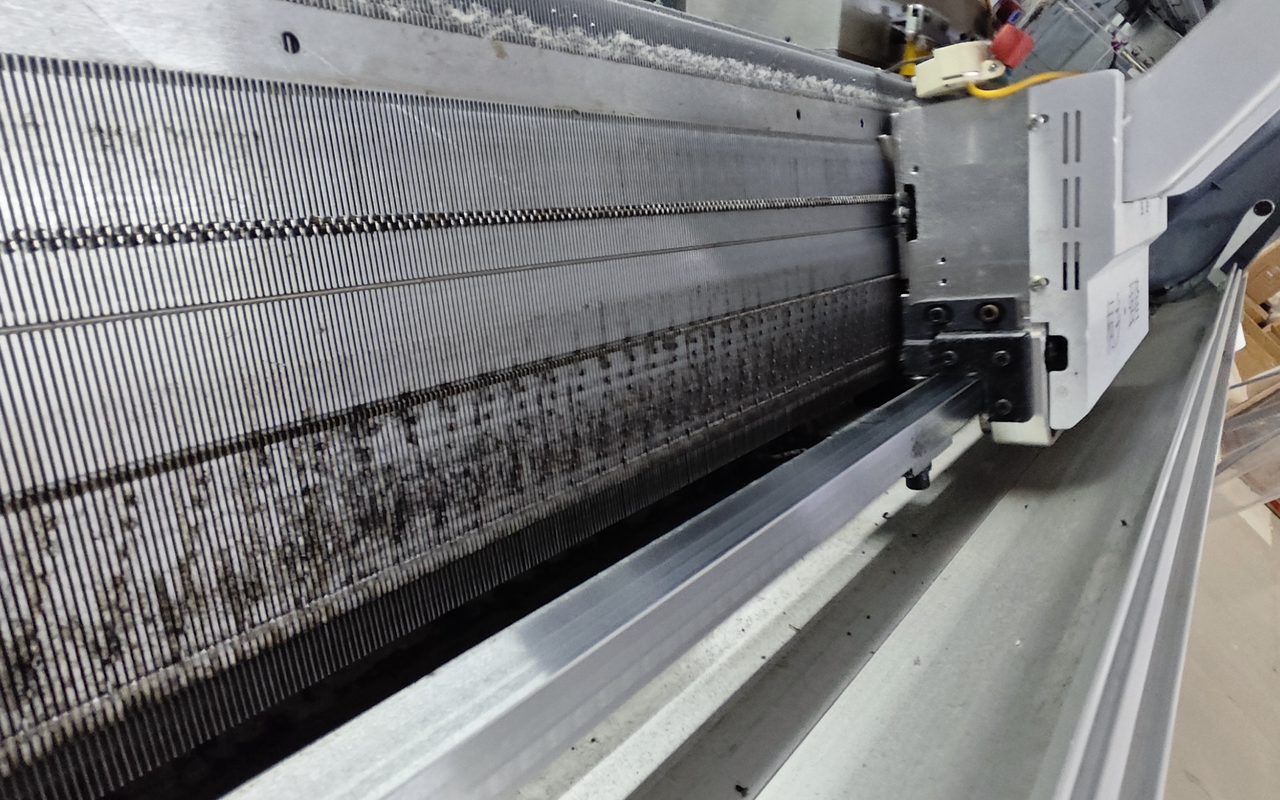
So do not treat the label, the invoice header or the website footer as evidence of a factory. Treat them as the start of a question. The practical test is simple: ask something only the person standing next to the machine could answer, and see how long the answer takes to come back.
Five roles, five different kinds of control
We find it useful to draw the order as two parallel chains. The upper chain is paperwork: who signs what with whom. The lower chain is physical: yarn becomes panels, panels become a garment, the garment becomes a carton. The two chains rarely have the same number of boxes.
| Role | Controls | Does not control | What a buyer should verify |
|---|---|---|---|
| Knitwear supplier / trading company | Quotation, consolidation, shipping, documents | Machine allocation, tension, first-panel waste | Which mill, and is the mill named in the quote? |
| Sweater manufacturer | Gauge, panels, linking, pressing, QC, ship date | Your retail price, your fabric choice if you specify it | Machine count, gauge range, in-house process list |
| Agent or sourcing office | Communication, inspection, consolidation | Any production decision | Who signs off the sample technically? |
| Dyeing / washing / trim partner | Hand-feel, shrinkage, labels, packing | Stitch structure, shoulder or neckline construction | Is the finish specified to the same standard as the sample? |
The useful question is not “are you a factory?” It is “which of these four rows can you sign for without asking someone else?” A trading company that answers honestly is often the right partner for a multi-product programme. A trading company that answers “we own everything” is the one that will struggle when you ask to move a seam by 6 mm.
What a mill can answer in one message
Here is the practical difference. These are questions we answer from our own floor, without a relay, and the numbers we give are the ones on our website. Buyers comparing a custom knit sweaters manufacturer with a general low-MOQ knitwear supplier can use the same list as a checklist.
| Question | Factory answer, first reply | Why it matters |
|---|---|---|
| What gauges do you run? | 3GG–16GG, 12GG and 14GG as the main configurations | Determines whether your structure is even possible |
| How many machines for 300 pieces? | 3–5 machines; roughly 10 for 1,000 pieces | Gives you a way to sanity-check a lead time |
| What happens to the first panels? | They are test panels and scrap; every new style needs tension tuning | Explains why “more machines” is not “faster” |
| How long is a sample? | 1–2 days for a simple style, 5–7 for a complex or special-yarn style | Separates a real schedule from a rounded one |
| Which steps are in your building? | Knitting, linking, sewing, washing, pressing, QC, packing | Fewer hand-offs, fewer places to lose a specification |
| What is your annual output? | 1,600,000 pieces on 120+ machines | A capacity ceiling, not a promise about your date |
A supplier who cannot answer a machine question in one message is not necessarily dishonest — they are simply not the party that owns the answer. The risk is not the delay itself. The risk is a confident number that nobody with a wrench has confirmed. We wrote about the machine-allocation logic in more detail in our sampling article; the short version is that a new style consumes test panels before it produces saleable ones.
Where a long chain loses your specification
A specification rarely disappears in one dramatic error. It erodes. A rib width becomes “standard”; a tolerance becomes “as sample”; a colour reference loses its lot number. By the time the instruction reaches the needle bed, the person setting the machine has a photograph and a verb.
Consider two examples from our own technical notes. Changing a shoulder from set-in to raglan moves roughly 10–20% of the armhole stitches from the body to the sleeve, which means the sleeve is re-knitted, not re-cut (shoulder types). Changing a neckline is not a styling footnote either: the band width in millimetres, the rib structure and whether the trim is linked or folded all have to be written down (neckline types).
The OECD sentence is about due diligence, not about knitting. It applies here for a plain reason: a fragmented chain is hard to manage for compliance, and it is just as hard to manage for stitch density. Every additional hand-off is another place where a numeric field can become an adjective.

Freeze the numbers before the sample, not after it. Gauge, yarn count, rib structure, band width, tolerance and carton dimensions belong on one page. If a partner cannot repeat those six fields back to you in writing, the chain between you and the machine is longer than your lead time can afford.
Do not qualify a supplier from a catalogue
These are the four mistakes we see most often when a brand moves from a first sample to a production order. None of them is about dishonesty. All of them are about asking the wrong party the wrong question.
The correction is cheap: put the process list and the numbers in the same email as the quote request. A factory will answer in kind. A desk will forward it — and the forwarding time is itself useful information about your real lead time.
Tool: quote field cross-check
Copy this into your next quote comparison. The middle column is what a sweater manufacturer should be able to fill in without a meeting. The right column tells you what a blank means. It is deliberately short: eight fields, one page.
| Quote field | What a mill writes | If it is blank or vague |
|---|---|---|
| Gauge | 12GG / 14GG, matched to yarn count | Structure has not been engineered yet |
| Yarn | Composition, count, dye-lot policy | Colour and shrinkage will drift between batches |
| Panel weight / finished weight | Measured after the specified wash and finish | Quote is based on greige panels, not the delivered garment |
| Structure details | Rib, neckline and shoulder method named | “As sample” with no numeric band width or tolerance |
| Machine allocation | Number of machines and test-panel allowance | Lead time is not derived from capacity |
| In-house process list | Which of the eight steps are owned | Unpriced subcontracting and unknown hand-offs |
| QC record | Measurement, weight, stitch inspection method | No defined acceptance standard at the carton |
| Carton / packing | Pack ratio, carton dimensions, labelling | Freight and shelf readiness are still estimates |
Use the same eight fields for a cardigan sweater manufacturer quote and for a custom Christmas jumper quote. The more decorative the style, the more a missing field costs you at the sample stage.
Eight questions, and what each answer sounds like
Ask these before you pay a deposit. The third column is the red flag — not proof of bad faith, but a sign that the answer came from a desk rather than a floor. Answers are paraphrases of the kind of reply we would give; they are not quotations from any customer.
| Ask | Factory-shaped answer | Red flag |
|---|---|---|
| 1. Which gauge and yarn count would you use for this structure? | A specific pairing, with a reason tied to hand-feel or drape. | “We can do any gauge you want.” |
| 2. How many machines will my 300-piece order occupy? | A number, plus a note that new styles need test panels. | “We have plenty of machines.” |
| 3. Which of the eight steps are in your own building? | A list with any subcontracted step named openly. | “All of them” with no address or process detail. |
| 4. How do you measure the finished weight? | After the wash and finish the order specifies, not off the machine. | A greige-panel figure presented as a garment weight. |
| 5. What happens if I change the neckline after the sample? | Re-knit the affected panels; band width and rib restated. | “No problem, small change.” |
| 6. Who signs off the QC record before packing? | A named in-house role and the checks performed. | “The supplier handles that.” |
| 7. What is your MOQ and why? | 50 pcs per style per colour, explained by one dye lot, one machine set-up, one trim set, one QC run. | A number with no physical explanation. |
| 8. Can I see the actual sample before it ships? | Photographs of the garment, not a swatch card. | Only a yarn card or a catalogue image. |
Eight answers, one page of notes, and you will know which chain you are buying from. If every answer arrives in one message with numbers attached, you are close to the needle bed. If each one arrives a day later with an adjective where a number should be, plan your schedule around the relay.
FAQ
Is a knitwear supplier worse than a sweater manufacturer?
Does the company name on a label prove who knitted the garment?
What is a realistic MOQ for custom knitwear, and why is there a floor?
How fast can a sweater manufacturer sample and produce?
What should I put in a tech pack for wholesale knitwear?
Can a jumper manufacturer handle a very small first order?
References
- 16 CFR § 303.16 — Arrangement and disclosure of information on labels, Electronic Code of Federal Regulations.
- 16 CFR § 303.19 — Name or other identification required to appear on labels, eCFR.
- 16 CFR § 303.2 — General requirements, eCFR.
- 15 U.S.C. § 70b — Misbranded and falsely advertised textile fiber products, Legal Information Institute, Cornell Law School.
- 15 U.S.C. § 70 — Textile Fiber Products Identification Act, definitions, Legal Information Institute.
- Regulation (EU) No 1007/2011 on textile fibre names and related labelling and marking of the fibre composition of textile products, Article 15(2), EUR-Lex.
- OECD, Responsible garment and footwear supply chains, OECD Centre for Responsible Business Conduct.
Regulatory text is quoted verbatim where marked; the factory figures in this article are our own published specifications. All links were checked on 12 November 2026.
Send the tech pack, or just the sketch
We will tell you which gauge, which yarn and how many machines your order actually needs — and whether the date on your quote is achievable.
WhatsApp / WeChat +86 137 1519 6498sychen@limingknitwear.com